

Share this post
What is a scope & sequence?
A scope and sequence is a planned curriculum for a book, course, or program. The scope refers to the range or breadth of material. The sequence refers to the order in which the content is meant to be used.
A curriculum or program may be organized by grade or proficiency level. In some cases, it's organized by subject matter (e.g., science) or theme (e.g., community). Ellii, on the other hand, is more of a content library than either a ready-made program or curriculum. However, we do have ready-made pathways to help if you are looking for more structure. Keep reading!
In this post, you'll find answers to the following frequently asked questions about Ellii:
- Does Ellii have a scope and sequence?
- Does Ellii have ready-made courses?
- Does Ellii have a suggested teaching order?
- Can I create my own curriculum with Ellii?
- What targets and themes should I focus on for each Ellii level?
- What if I don't know what Ellii level my students are?
- Can I assess my students with Ellii?
Does Ellii have a scope & sequence?
If you're used to using a textbook series, you may be wondering where to find Ellii's scope and sequence information.
Ellii (formerly ESL Library) has 2,500+ ready-made lessons and resources as well as 4,000+ flashcards. We also have videos, prompts, and other activities for teaching English for every age, level, and need. Our in-house publishing team adds new content daily based on teachers' requests and needs.
Teachers from all over the world use Ellii in a variety of ways. Ellii materials can be used...
- in traditional classrooms
- in online and hybrid classes
- to complement an existing curriculum (e.g., further practice with a target or theme)
- to build a curriculum
- to supplement a curriculum (e.g., lessons on holidays, current events, etc.)
- to focus on a certain macro (e.g., reading) or micro (e.g., grammar) skill
Teachers also use Elli with a variety of types of English learners. Teachers use Ellii with...
- adult newcomers who require life skills and foundational English content
- K–12 or higher-ed students who need English for academic purposes
- 1:1 learners who need to learn English for specific purposes, such as workplace English or conversation English, or for improving a particular skill
- multilevel classes
At Ellii, we believe teachers know their students best! Rather than developing a single program that may or may not work for all students in a class, we focus on creating high-quality materials for every age, level, and need.
However, if you aren't sure what you need, we do offer mini-courses, collections, and a suggested teaching order for some sections.
Read on for Ellii tools and features that make planning easier.
Does Ellii have ready-made courses?
Yes, and this area of Ellii is growing quickly. Visit our Courses & Study Packs area and watch this library grow.
Example Courses & Packs
Here are just a few of our ready-made Courses & Packs:
- Grammar Courses 1–9 (Grammar)
- Ellii Up A – Z (General English)
- Simple Present Power Pack (Grammar)
- Pre-Employment (Workplace)
- Functional Business (Workplace)
- English at Work (Workplace)
- Travel in English (Dialogues)
- Essay Essentials (Academic)
- Everyday Idioms 1 (Vocabulary)
- Detective Series 1 (Vocabulary)
- Medical Matters (Life Skills)
- Banking Basics (Life Skills)
- Partners in Progress (Academic)
- Moon Time (YL)
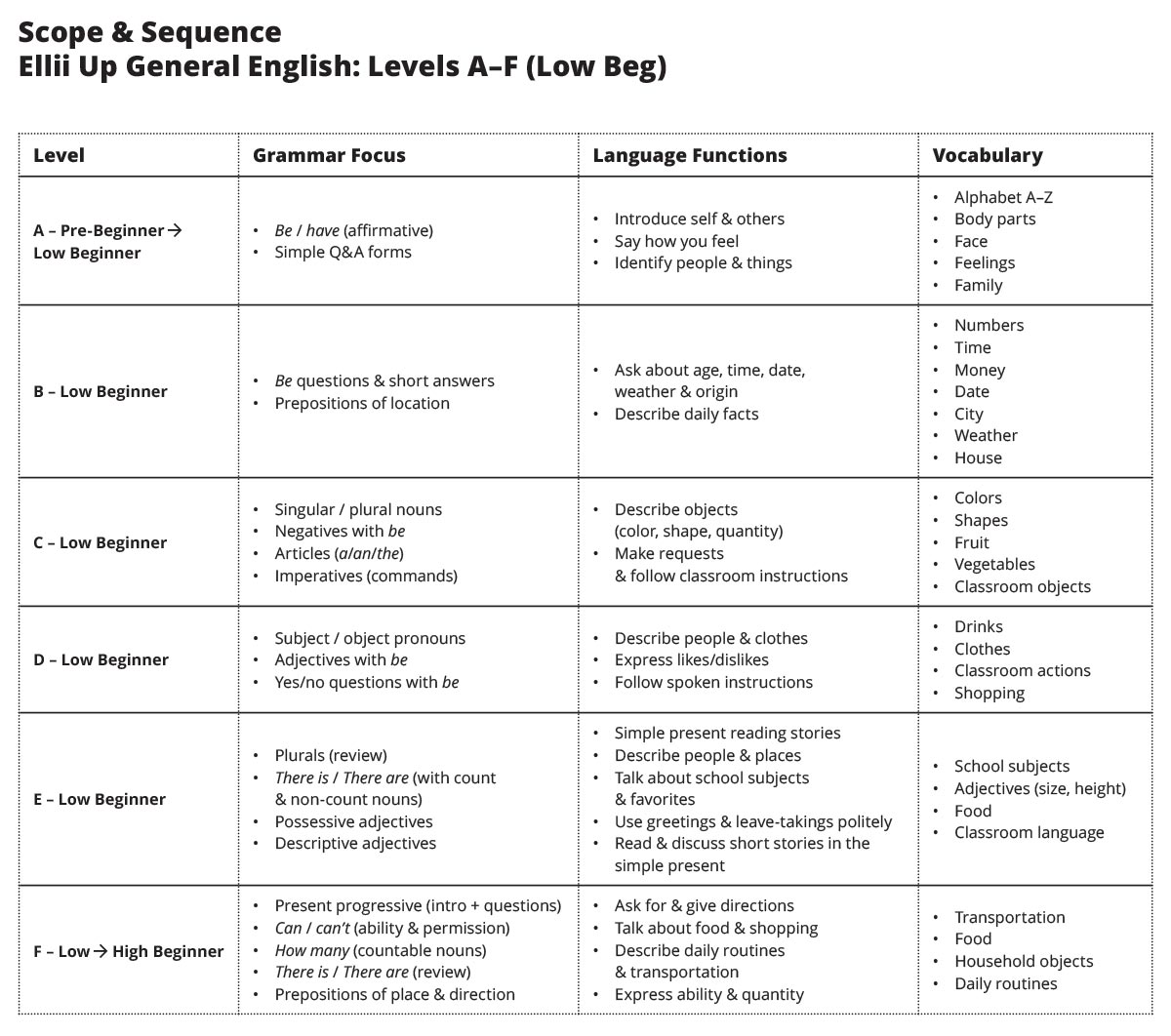
Here is the scope & sequence for Ellii Up A–E (low beginner).
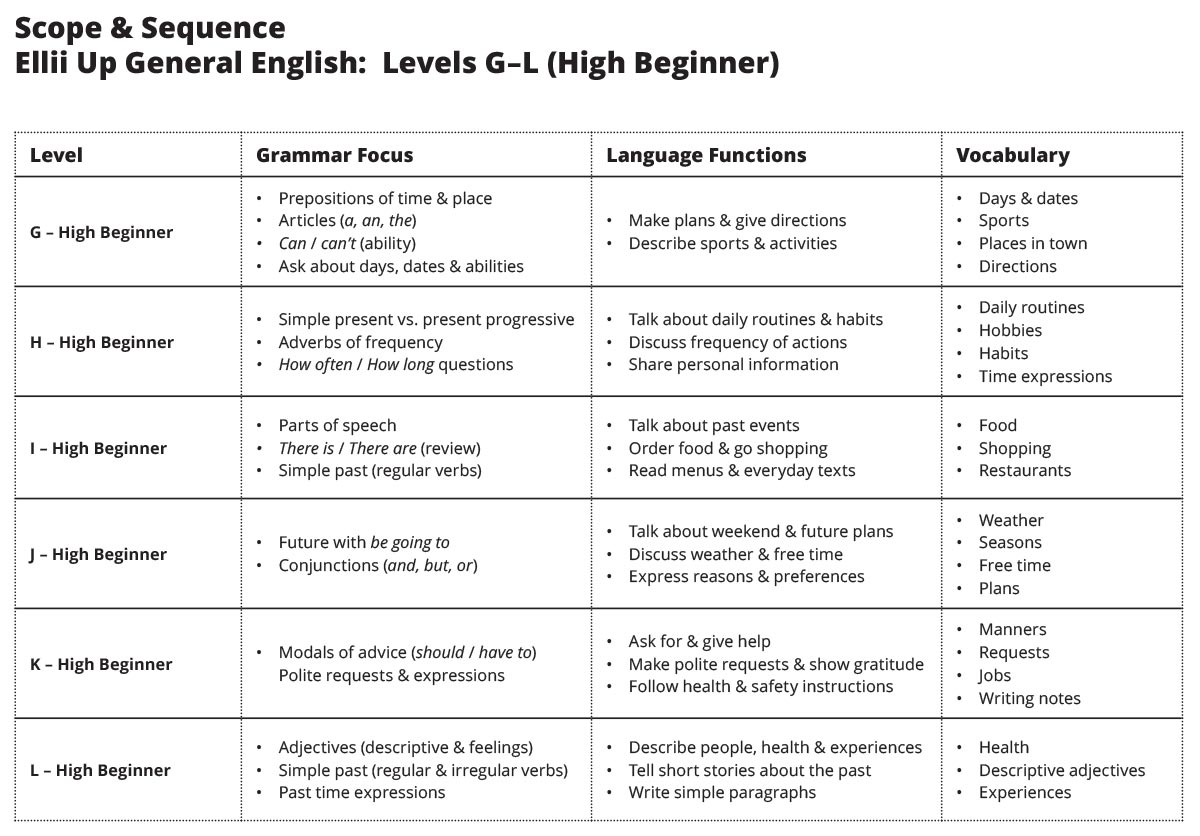
Here is the scope & sequence for Ellii Up G–L (high beginner).
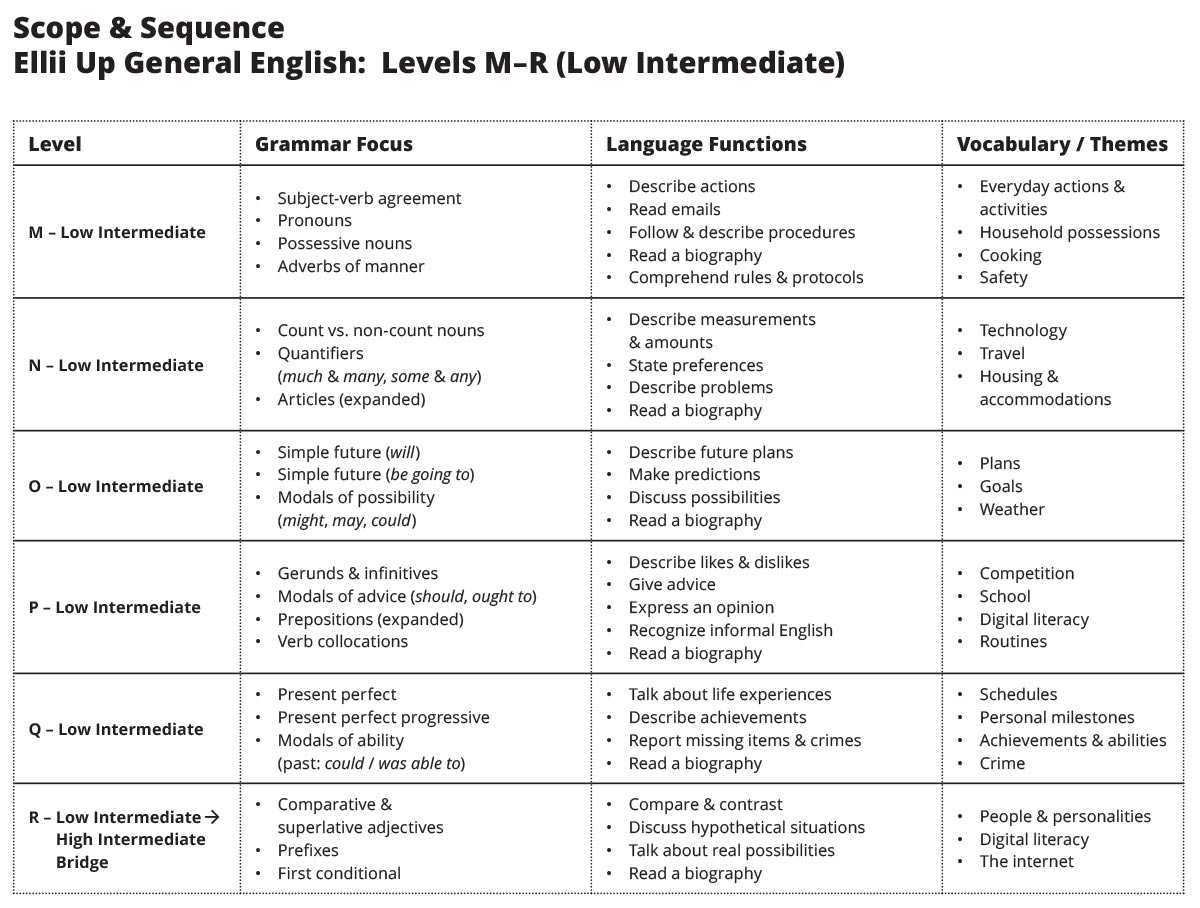
Here is the scope & sequence for Ellii Up M–R (low intermediate)
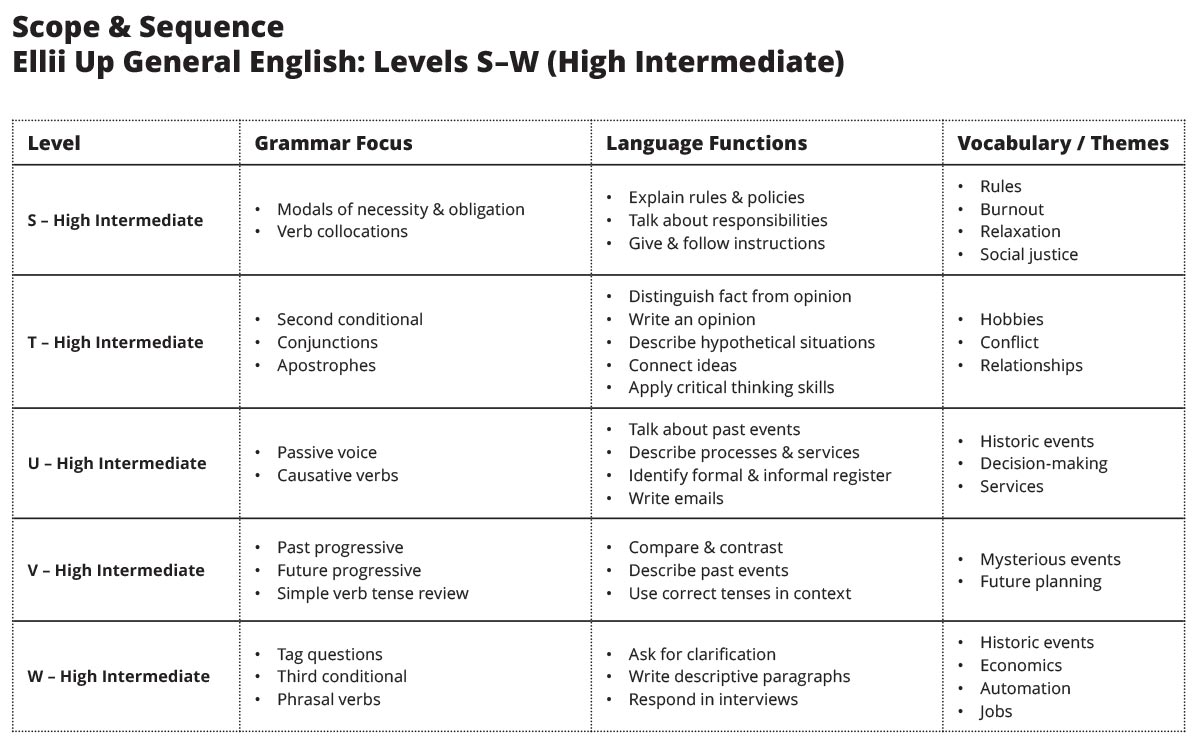
Here is the scope & sequence for Ellii Up S–W (high intermediate).
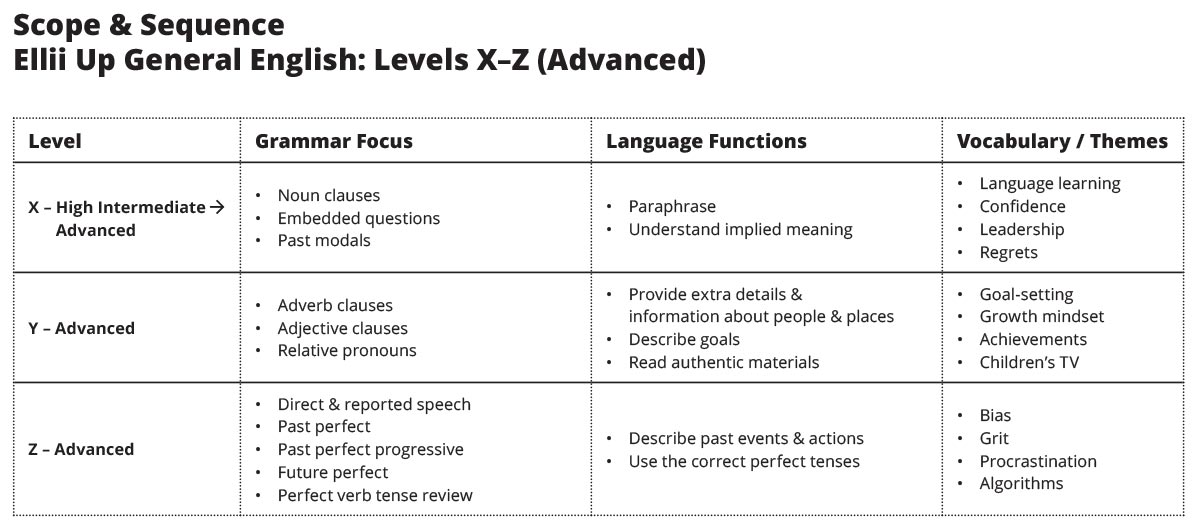
Here is the Scope & Sequence for Ellii Up X– Z (Advanced)
Please get in touch if there's a specific course or pack that would be helpful for your students. Be sure to mention their age, level, and specific needs.
Does Ellii have a suggested teaching order?
Ellii's materials are divided into lesson and resource sections.
Within one section, you will find content that's formatted in a similar way.
Some of Ellii's lesson sections have a built-in teaching order. We don't recommend only using content from within one section (unless it's a serial). However, we do recommend that you teach targets at the recommended proficiency level.
Here are some sections that have a Teaching Order. (This may not be the default sort filter, so you will need to change the category sort filter to Teaching Order.)
- Super Simple Grammar
- Super Simple Questions
- Functional English
- Grammar Practive Worksheets (Teens & Adults) or Fun Grammar Lessons (YL)
- Basic Grammar Sentences
- Grammar Stories
Note that if you choose the Teaching Order sort filter in our Holidays & Events section, you will see the content sorted by calendar order.
Can I create my own curriculum with Ellii?
Yes! You can save and create your own materials to build a curriculum that meets the needs of your class or even one student.
Learn all about how to use the Lesson Planner here.
More:
We recommend using our Collections to find content from all different sections based on the theme, target, subject, or competency. You can then filter by level or age. When you click into the content, you can save it to your folder of choice.
Here are some popular ways to use some of our Collections:
- Find content by What's New
- Find content by Grammar Target and Level/Age
- Find content by Academic Subject and Level/Age
- Find content by CLB or CASAS competency
What targets and themes should I focus on for each level?
Here are some suggested targets, themes, and learning objectives for each proficiency level. Visit our Equivalency Scale for more information about levels.
| Ellii level | Suggested grammar targets | Suggested themes | Learning objectives |
|---|---|---|---|
| Pre Beg | be, have, simple present, nouns, adjectives, yes/no questions, can | colors, shapes, letters, numbers, signs | identify letters and some numbers, count, read signs, understand very familiar everyday words or expressions (survival English) |
| Low Beg | be,simple present, singluar & plural nouns, articles, pronnouns, imperative verbs | familiar objects, food, daily routines, animals, family, body, familiar verbs, people, community | say and read high-frequency words with visual support, describe everyday actions, describe familiar people and things, read and say short sentences, give date and time, give commands or warnings, describe daily routines |
| High Beg | modals of ability - present, present progressive, simple present vs. present progressive, adverbs of frequency, prepositions of time, prepositions of place, parts of speech, simple past, there is there are, yes/no questions, wh- questions, adjectives | stories, surveys, fables, shopping, restaurants, directions, travel, short narratives (fiction and non-fiction), health | listen and read along to short stories, ask and answer simple questions, give personal information, write simple sentences, listen and comprehend more familiar information, understand and give directions |
| Low Int | modals of ability - past, count vs. non-count nouns, quantifiers, possessive nouns, articles, adverbs of manner, prepositions, simple future, subject-verb agreement, pronouns, gerunds and infinitives, modals of advice, modals of possiblity, present perfect, present perfect progressive, comparatives | workplace, sports, holidays and culture, fashion, biographies, education, school | describe future plans, describe likes and preferences, follow and describe procedures, compare and contrast, make suggestions, discuss unreal situations and possibilities, understand information on less familiar topics, recognize informal English |
| High Int | present perfect, present perfect progressive, modals verb collocations, first conditional, equative, second conditional, comparative and superlative adjectives, comparatives, present perfect, present perfect progressive, modas of necessity and obligation, conjunctions | current events, workplace, relationships, environment, historic events, soft skills | discuss complex issues, offer a personal response, use academic and business vocabulary, work independently in groups, understand more natural everyday English, critical thinking |
| Adv | tag questions, past progressive, future progressive, phrasal verbs, passive, causative verbs, third conditional, past modals, adjective clauses, adjective phrases, adverb clauses, passive causative, direct and reported speech, embedded questions, past perfect, past perfect progressive, subjunctive, noun clauses, future perfect, future perfect progressive | psychology, technology, politics, business, media, human rights, social justice, crime and punishment, law | debate and discuss controversial topics, work on projects, read some authentic materials, argue, understand and use collocations and phrasal verbs, comprehend information at natural speeds, understand more idiomatic language and slang |
What if I don't know what level my students are?
Try Ellii's Placement Test (60-minute, 4-skills) or Ellii's Placement Quiz (30-minute, M/C). You can also use our Grammar Tests and Language Scenes for placement.
Can I assess my students' progress with Ellii?
Ellii offers formative assessment opportunities in every lesson. In the digital versions, you can view your students' results. (Some tasks require manual scoring by the teacher.)
Each lesson section offers a different approach to assessment. Some lessons include a formal assessment task at the end.
For example, all of our Grammar Practice Worksheets lessons have a quiz to check the understanding of the target. Other lesson sections, such as Functional English, have assessments at the end of the lessons with ready-made rubrics.
We also have ready-made generic assessment tools that you can use or adapt to your own needs. You'll also find summative assessments in our mini-courses and some serials.
What leveling and standards does Ellii align with?
Teachers all over the world use Ellii for a variety of ages and levels, so we do not stick with one specific system. We have an Equivalency Scale to help you out and we try to tag our content with every search term imaginable. Some teachers use CEFR levels and others use CLBs or ELDs. Others use something more aligned with specific assessments, such as CASAS competencies or NRS levels. In your Account settings, you can choose to view Ellii's levels and correlations in a few different ways. We are always adding new tags and filters, so let us know what you or your program needs! The Focus area of our lessons also includes modalities that may be useful for you to see.
We hope you find everything you need!
Comments
Comments are turned off for this post.