
Share this post
Indefinite pronouns are words that refer to nonspecific people, places, things, amounts, or ideas. They help us express generalities rather than specifics. Unlike personal pronouns, which refer to a known noun, indefinite pronouns are intentionally vague.
Ambiguity & context
The very nature of indefinite pronouns brings ambiguity to language. Without a clear antecedent, the referent becomes open to interpretation. For example, consider the following sentence: "Someone left their umbrella behind." Here, we don't know who that "someone" is, making it impossible to determine the gender or identity of the umbrella's owner. The absence of a specific antecedent makes indefinite pronouns both versatile and challenging.
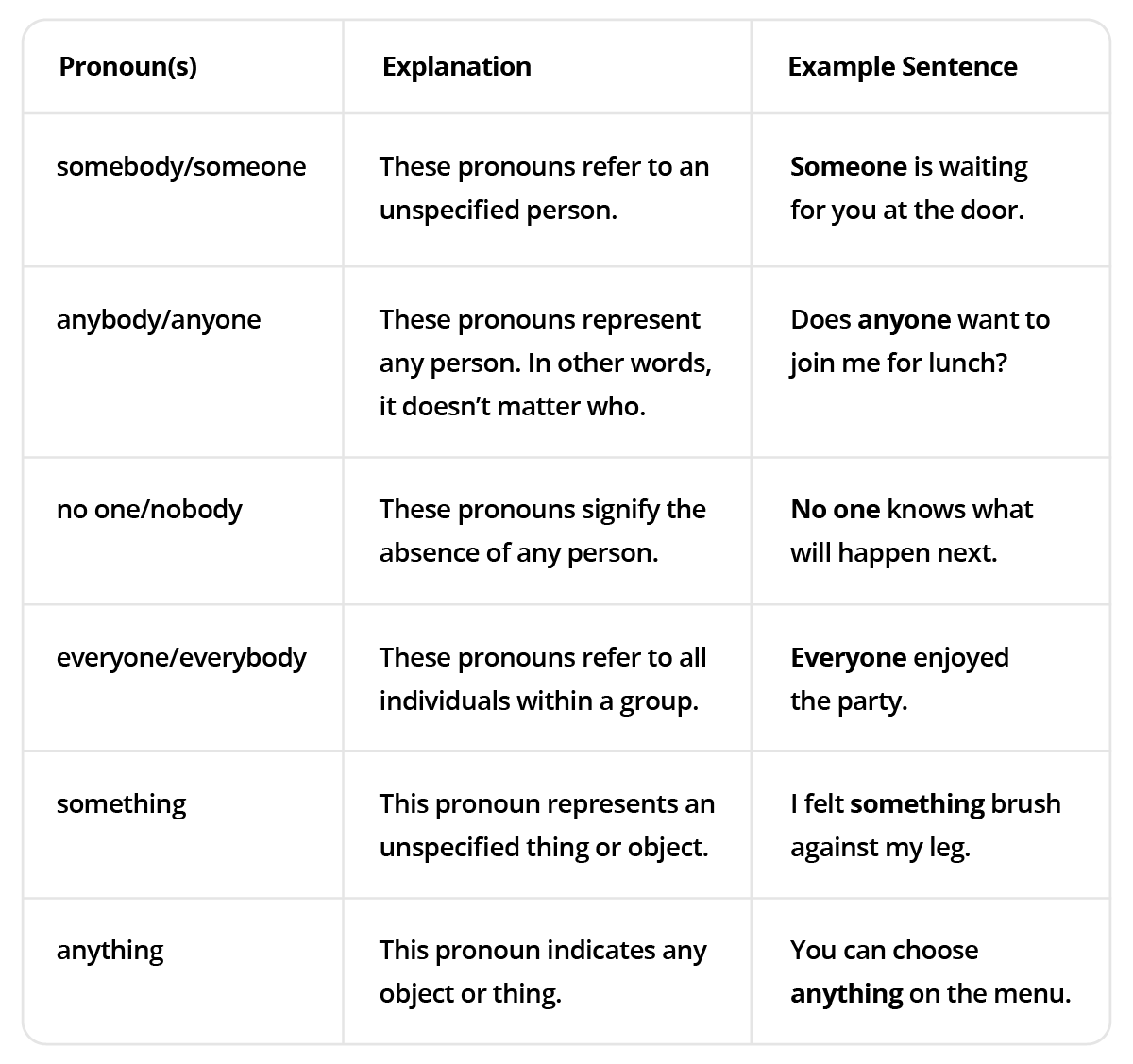
Common indefinite pronouns
Let's explore some frequently used indefinite pronouns:
Tips & tricks
1. Function & form
Indefinite pronouns can be used in both the subject position and the object position within a sentence. Unlike personal pronouns (I/me, she/her, they/ them, etc.) whose form changes depending on their function, indefinite pronouns stay the same regardless of their role in the sentence.
- Someone left the door open. (subject)
- I met someone from Nigeria yesterday. (object)
- Anyone who buys a lottery ticket has a chance of winning. (subject)
- Maria doesn't know anyone at her new school. (object)
2. Subject-verb agreement
a. Indefinite pronouns that end in -one, -body, and -thing are usually treated as singular. Each also takes a singular verb.
- I rang the doorbell, but nobody was home.
- Everybody knows that I hate eggs.
- Someone is knocking at the front door.
- Everything is already in the car, and we are ready to leave.
b. Both, few, many, others, and several always take a plural verb.
- Many of the students drive to school, but others walk or take the bus.
- Both of my sisters like to write poetry.
- Many are called, but few are chosen.
- Several of my friends live in my neighborhood.
c. Depending on the context, some indefinite pronouns can be either singular or plural. These include all, any, none, and some. If one of the indefinite pronouns in this group is referencing an uncountable noun, a singular verb is used. On the other hand, if the pronoun is referencing a countable quantity, the verb is plural.
- All of the fruit is rotten.
- All of the children are sick.
- None of the story was true.
- None of my answers were correct.
Note: When all is followed by a relative clause, it takes a singular verb.
- All that matters is your happiness.
- All that happened that night has been forgotten.
3. "Else"
Unlike most other pronouns, indefinite pronouns can be modified by an adjective. The adjective most commonly used to modify these pronouns is else. Else is placed after the indefinite pronoun, and we use it to refer to people, places, or things in addition to the ones we've already mentioned.
- After I ordered a salad and a cup of coffee, the server wanted to know if I wanted anything else.
- If Amir can't give me a ride to work, I'll ask someone else.
- We invited my family and close friends to our wedding, but no one else.
4. Referring back to "somebody" & "someone"
In most cases, we don't know if someone or somebody is a male or female. To acknowledge this ambiguity, we often use the plural pronoun they to refer back to (singular) someone/somebody in everyday spoken English.
- As I was walking across the parking lot, I noticed that somebody left their headlights on.
- When you first meet someone, it is considered rude to ask them how old they are or how much money they make.
Summary
Indefinite pronouns add depth and versatility to our language. They allow us to generalize our statements so that we can include a wider range of individuals or situations. By employing these pronouns, we can express ideas, experiences, or beliefs that apply universally. For instance, saying "Everyone appreciates kindness" or "Nobody likes to be left out" helps us address shared experiences without singling out particular individuals. As a result, we can avoid making assumptions and judgments about specific people or groups.

Comments (2)

alice hanes(Guest)
October 31, 2023 at 7:08 pm

Ann Dickson(Author)
November 1, 2023 at 1:13 pm

Ruslana S.(Teacher)
July 21, 2025 at 3:54 pm