

Share this post
There are several commonly confused word pairs in English that cause a great deal of angst in everyone from English language learners to native speakers, and the terms affect and effect surely top the list. Time and again, I've seen my students struggling to recall when to use these terms. I've found that teaching a mini-lesson on the pair, such as the one below, goes a long way to helping students remember which is which.
Quick Tip
A is for Action! The verb affect starts with an A, and a verb is an action, which also starts with an A.
Comparison
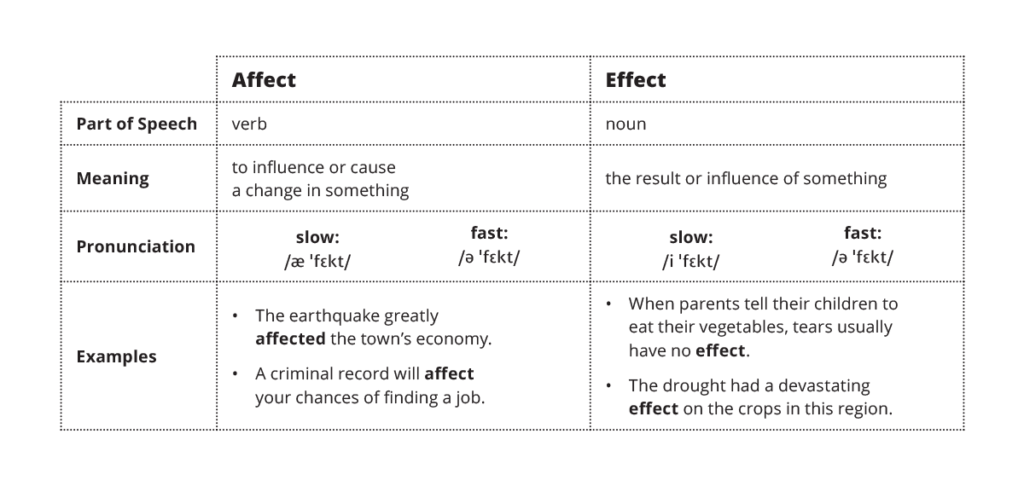
Affect and effect are confusing because they have similar meanings and pronunciation (when speaking quickly and naturally). The easiest way to tell them apart is to look at sentence patterns. Does the word follow a subject and act as the action in the sentence? If yes, use the verb affect. Does the word take a subject or object position before or after a verb (action) in the sentence? If yes, use the noun effect. The following chart shows the similarities and differences between these two terms.
Practice
Our new Historic Events lesson on The Great Depression has a page of practice on affect and effect (page 4). You could also have students find these words in context in the reading on page 2. The Great Barrier Reef (a Famous Places lesson) also has affect in context in the reading on page 2 (coming soon).
Other Commonly Confused Words
This blog post, 6 Commonly Confused Word Pairs, has more word pairs that English learners (and native speakers) often confuse. It includes tips on advice/advise, accept/except, especially/specially, emigrate/immigrate, and custom/customs.
Comments


There are no comments on this post. Start the conversation!