
Share this post
English is always changing and growing. Although it started life in England, over the centuries it has traveled the globe. Now, around 1.5 billion people around the world use it every day to communicate.
These users are not all so-called "native speakers." Most of these users have learned it as an additional language.
There are many ways to speak English
There is often a mistaken belief that there is one "correct" way of speaking English. This is impossible.
Around 75 countries use it as their official language. Each one uses it in their own special way.
And within each country, people use it differently in different areas, cities, and towns. This gives us an interesting mix of accents and words.
People often think of British English or Amercian English as the "correct" models. But in Britain, there is Brummie (Birmingham English), Cockney (London English), and Glaswegian (Glasgow English)—to give just three examples. In the US, there's Southern (e.g., Texan), Mid-Atlantic (e.g., New York), and Western (e.g., Californian).
If you'd like to know more, check out my posts on the use of English in countries like Australia, Scotland, and Ireland.
The three circles of English speakers
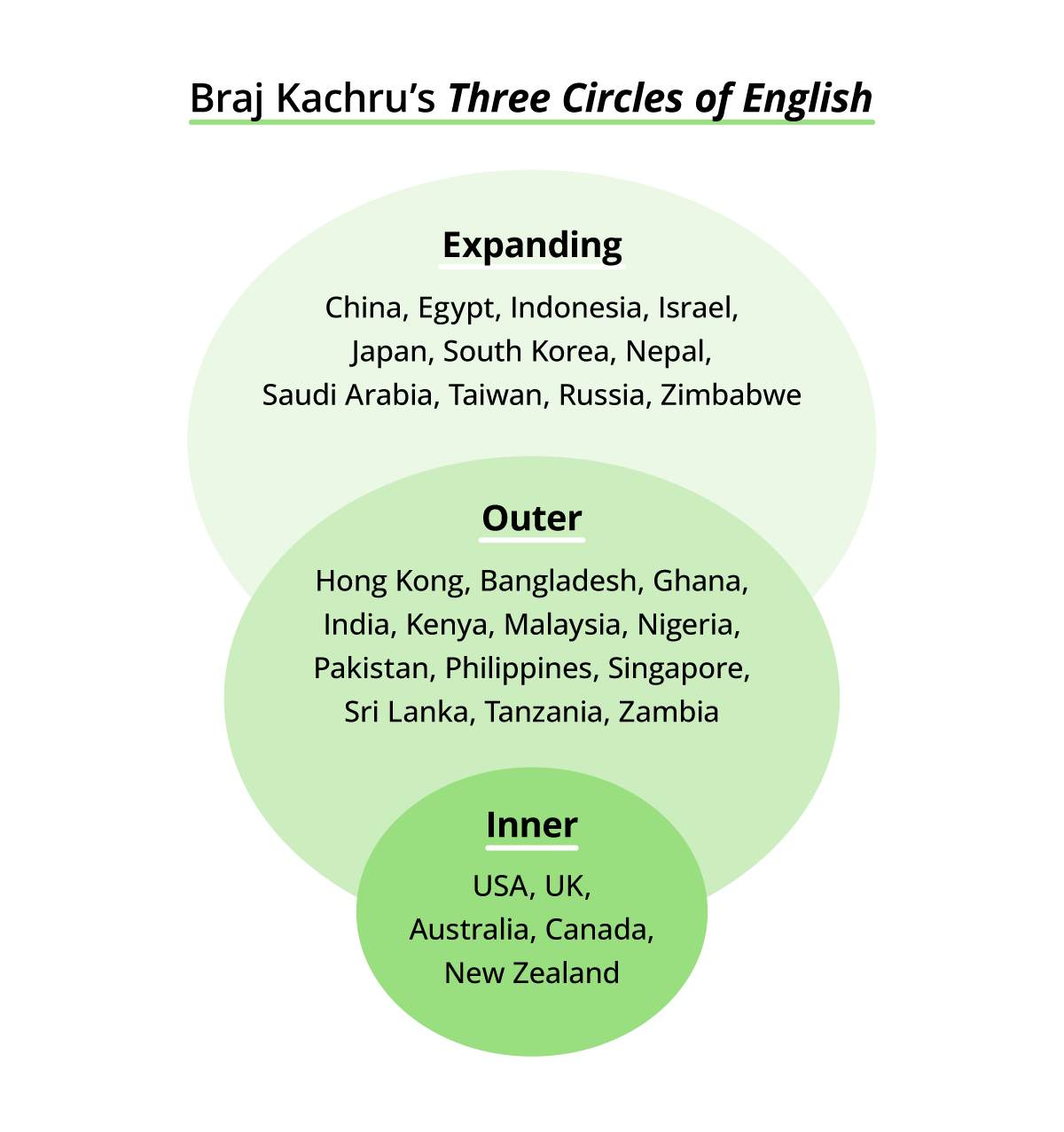
In 1992, Braj Kachru created the three circle model of English speakers. He wanted to explore the use and status of different Englishes around the world.
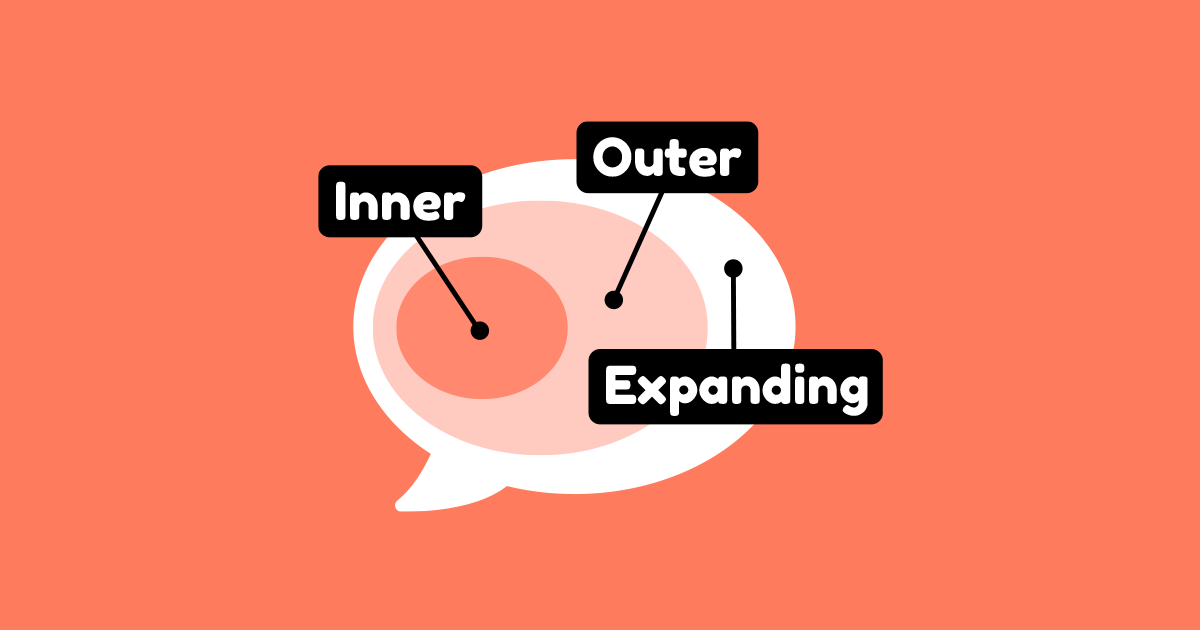
He categorized them into the inner, outer, and expanding circles.
The inner circle
The "inner circle" includes the US, UK, Canada, Australia, and New Zealand. These are countries that historically spoke English first.
The Englishes from these countries are often used as models or "norms" for English language learners. This is why many language teaching resources use American or British English as examples in class.
This is also why some language schools continue the discriminatory practice of hiring language teachers from these countries rather than focusing on proficiency, lingusitic knowledge, or teaching expertise.
However, there is a growing awareness that English is global. Speakers around the world are now challenging the outdated belief that so called "native" speakers from "inner circle" countries use the language more effectively.
The outer circle
The "outer circle" includes countries where English may not be the most common language, but is an important or official language.
For example, India, Kenya, Malaysia, and Singapore started using the language when they were part of the British Empire. Like Australian, Irish, and Scottish English, their Englishes have unique differences in vocabulary, grammar, and pronunciation.
Although English speakers from these countries have grown up using the language, they are often mistakenly considered "non-native" speakers.
This is due to the incorrect perception that English belongs to "inner circle" countries.
In reality, English belongs to everyone. Every user can make it their own.
The expanding circle
The "expanding circle" refers to countries that have never had English as an official language, but still use it as a lingua franca. For example, English is an important language in Argentina, Egypt, and South Korea.
Although English is not an official language, many people in these countries want to learn it in order to enhance their careers and communicate confidently around the world.
How does the "Three Circles of English Speakers" model impact our classroom practice?
As language teachers, we need to be aware that there is not one correct way to speak English. Everyone uses it in their own way. The most important goal is to be understood.
This means that we need to adapt our classroom practices to our learners' needs. Every learner has different reasons for learning and will use their language skills in different places.
It can be helpful to introduce learners to different accents and uses of the language. This supports them to adapt when they meet people who use an unfamiliar English.
We can also give learners confidence in knowing that even speakers from so-called "inner circle" countries can find each other hard to understand. Let them practice skills such as checking meaning, rephrasing, and adapting their pronunciation in order to be understood.
Finally, and most importantly, let them discover their own voice in English. Everyone uses English differently. Things that speakers from one country think are "incorrect" or "weird" may be very common in another.
Think about your own use of English. In what ways do you use it differently to other people you know?
If you enjoyed this blog post, we think you'll love these posts too:
- ELF Pron: What Is It & How Can We Teach It?
- The History of English
- Australian English for ESL Learners: Common Phrases & Expressions for Clear Communication
- Essential Scottish English for English Language Learners: Common Phrases & Expressions
- Irish English for ESL Learners: Common Phrases & Expressions
Comments (1)

Iris Y.(Teacher)
August 4, 2026 at 3:09 am

Tanya Trusler(Author)
August 4, 2026 at 6:26 pm