Australian English for ESL Learners: Common Phrases & Expressions for Clear Communication

May 4, 2026
Share this post
Even though English is global, it is spoken differently in many parts of the world. American and British English are probably the most commonly taught in language classrooms. Ellii, for example, is a Canadian company, but it offers language learning content in American, Canadian, and British English.
Around the world, about 75 countries have English as an officical language. Countries like Australia, Ireland, New Zealand, and South Africa are the obvious ones. There's also Nigeria, Singapore, India, Philllipines, and many others.
On a recent trip to Australia, I learned that Scottish English and Australian English have many differences. I had to use my communication skills to help me understand and be understood.
It was an excellent reminder that even so-called "native" speakers can misunderstand each other!
How can we communicate across many different Englishes?
Different countries use different words, pronounce things in different ways, and have different grammar. For example, Scotland and Australia have different words for many things and use different vowel sounds.
In order to be understood, I used my communication skills:
- I slowed down.
- I left spaces between my words.
- I asked people to rephrase or repeat what they said.
- I asked questions to check I (and they) understood.
- I tried using different words or saying things in different ways.
- I pronounced consonsant sounds clearly and changed the vowel sounds in some of my words.
- I avoided using Scottish words and learned some Australian ones to use instead.
In this blog post, I want to tell the world that we all have to change how we communicate in order to be understood.
I also want to tell language learners that even people who speak English very well can misunderstand each other.
And I want to share some Australian English that helped me understand the people I met. I still speak English my own way, but I do occasionally use some of these words to be understood.
Australians shorten words with "y" or "o"
In Australia, people like to shorten words. They do this by adding "o" or "y/ie/ies." They do this even with friends' names. For example:
-y/ie/ies:
- Mel (popular girl's name) > Melly
- Australian > Aussie
- volunteer > vollie
- schnitzel (popular dish of crumbed meat) > schnitie
- parmigiana (schnitzel topping of ham and tomato sauce) > parmi
o:
- Damien > Damo
- Dave > Davo
- service station > servo (US: gas station, UK: petrol station)
Heaps
In Australia, it is more common to say "heaps" instead of "lots" or "loads." For example:
A: How many lollies are there?
B: There are heaps of lollies.
Lollies are not lollipops!
In the UK, lollies come on a stick. Most commonly, they are a boiled sweet on a paper stick, but they may also be frozen "ice lollies" on a wooden stick.
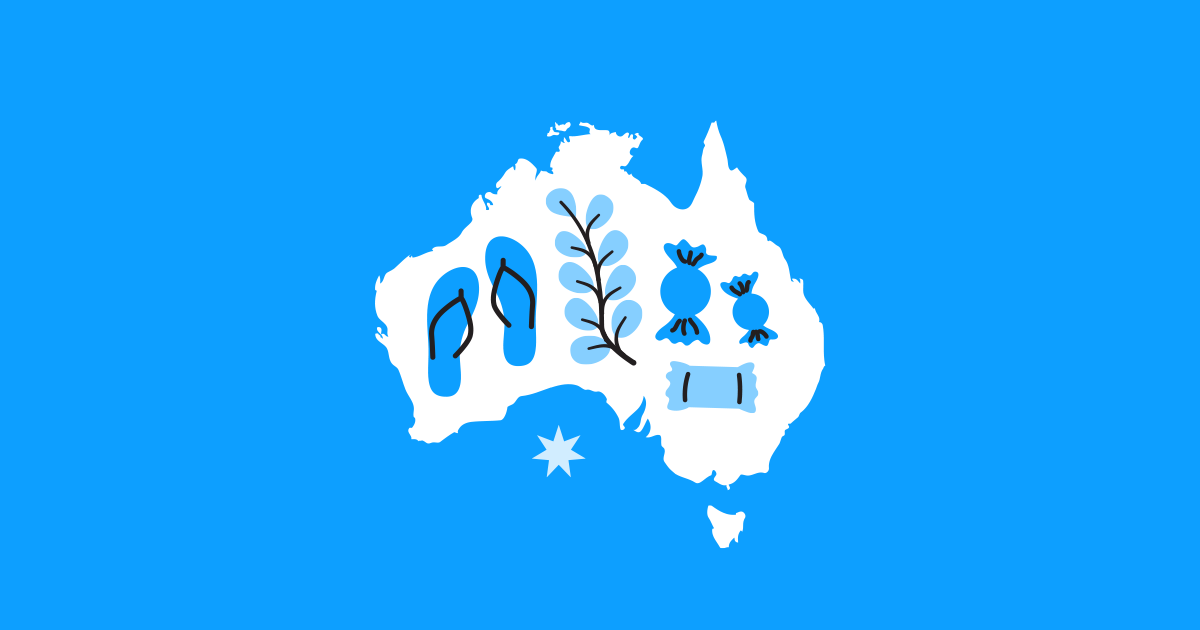
In Australia, lollies are any sweet (or candy, if you use American English)—boiled, chewy, on a stick, or in a wrapper. If it's made with heaps of sugar, it's a lolly!
My nephews and nieces introduced me to the idea of a "long way lolly." In the UK, this would be a "car sweet." I'm not sure if this phrase is used across Australia or just by nephews and nieces to make their auntie buy them sweets! Either way, we were driving a long way, so we bought heaps of lollies to keep us going!
How you going?
This greeting was perhaps what surprised me the most about Australian English. Instead of asking "How are you?," "How are you doing?," or "How's things?," Aussies will say "How you going?"
The answers remain the same. "Good," "Well," "Alright." Much like in British English, no one really wants to hear a long answer or a sad, negative reply!
G'day, mate!
To say "hello" to someone, Aussies often use "hi," "hey," and "How you going?," but they'll also use the more stereotypically Aussie "G'day, mate!," shortened from "Good day, mate!"
Many of the people who said "G'day, mate!" to me had never met me before. In Australia, "mate" is a friendly greeting as much as it means "friends."
Hearing this reminded me a lot of Scotland. We like to say "Alright, pal!" to people we have never met before.
Other random words
I could write forever about the words and phrases I've learned in Australia. But I need to stop and start summarizing somewhere.
Here are some more interesting differences:
- fairy floss (Aus) - cotton candy (US) - candy floss (UK)
- paddock (Aus) - field (US/UK)
- thongs (Aus) - flip-flops (US/UK)
- op shop: opportunity shop (Aus) - thrift store (US) - charity shop (UK)
- gum tree (Aus) - eucalyptus tree (US & UK)
- rug (Aus) - blanket (UK)
- pathway (Aus) - pavement (UK) - sidewalk (US)
What experience do you have with Australian English or other Englishes? We'd love to know. Please share your experiences with us so we can learn more!
Here are some other posts, lessons, and collections that we think you'll like:
English Belongs to Everyone: Here's How to Own Your English!
Comments


There are no comments on this post. Start the conversation!