
Share this post
After this lesson, I hope my students understand when to use these verbs. Actually, I wish they already understood!
This week our head writer, Tara Benwell, is working on a Discussion Starters lesson plan about Hosting the World, a lesson on hosting huge events like the World Cup or the Olympics. This lesson includes a review of the verbs hope and wish, so I decided to make a comparison chart that you can use in class. I also included a printable exercise sheet at the end. We hope this post helps your students keep the different grammar patterns for these two verbs straight!
Hope Vs. Wish
Hope and wish have very similar meanings. We use them to express our desire for something different from how it is now. In a nutshell, hope mainly expresses a desire that is possible or likely to happen. Wish usually expresses a desire that is impossible or unlikely to happen. To express a future desire, hope usually takes a simple present verb, and wish mostly follows the pattern of the second conditional (i.e., using would and other past patterns). In the past, wish follows the pattern of the third conditional (i.e., using had + p.p.).

Notes
Sentences with hope and wish are usually followed by a noun clause starting with that. In English, we often drop that from noun clauses, especially in informal speaking and writing. Point this out to students by giving them these two examples, which have the same meaning: I hope that I pass the test. / I hope I pass the test. You may also want to point out that it is possible, though less common, to use hope and wish with other types of phrases (e.g., I hope to pass the test. / I wish for rain tomorrow.)
Was or Were?
Because wish is a subjunctive verb, it follows the same pattern as the second conditional where the Be verb is concerned (i.e., traditional grammar dictates we should always use were and never was, even when the subject is I, he, she, a singular count noun, or a non‑count noun, as demonstrated in the chart above). But should we teach this to our students when so many native speakers ignore this rule? Well, I like to advise my students to follow this rule (since it is the “correct grammar”), but I do point out that it is becoming less popular these days to do so. Whether this is because it’s becoming a fossilized mistake or because English is legitimately evolving away from the formality of the subjunctive is an argument for another day!
Practice
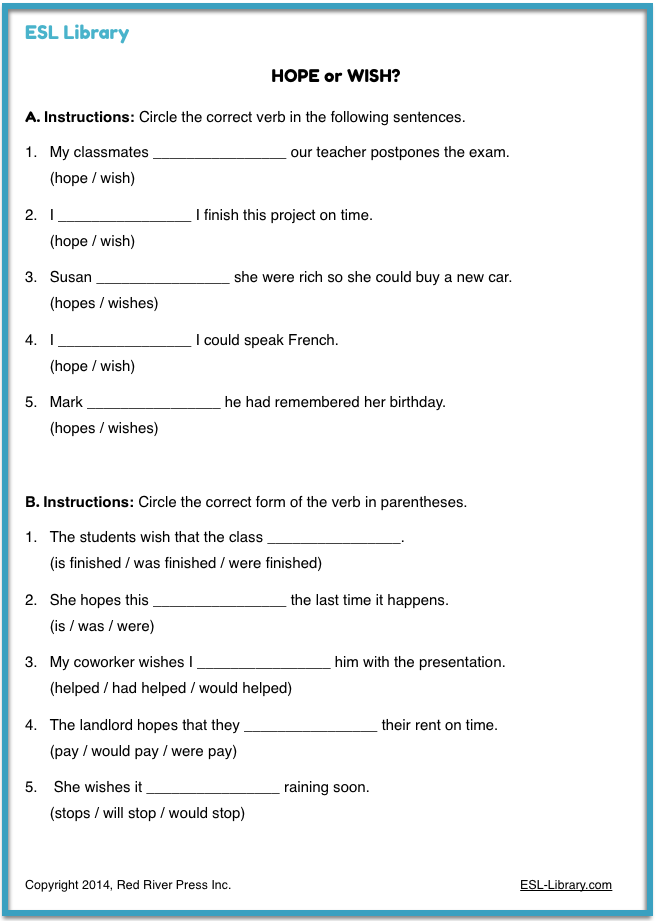
Download Hope Vs. Wish Exercises PDF
Answers
| Part A | Part B |
|---|---|
|
|
References
Azar, Betty Schrampfer. Understanding and Using English Grammar, second edition. Prentice Hall Regents, NJ.
Bonus Question
Can your students tell you what tenses and patterns were used in the introductory sentences to this post?
Answers
Sentence #1
“After this lesson, I hope my students understand when to use these verbs.”
| Verb | hope |
|---|---|
| Tense | future |
| Pattern | hope / present |
Sentence #2
“Actually, I wish they already understood.”
| Verb | wish |
|---|---|
| Tense | present |
| Pattern | wish / past |
Comments (23)

Marilena P.(Teacher)
June 28, 2014 at 2:49 am

Tanya Trusler(Author)
June 30, 2014 at 9:33 pm

Elisabete (Guest)
September 9, 2015 at 2:03 am
Tanya Trusler(Author)
September 9, 2015 at 3:13 am
Cristel Marcos(Guest)
December 3, 2015 at 4:21 pm
Tanya Trusler(Author)
December 4, 2015 at 12:51 am
rith (Guest)
December 14, 2015 at 8:14 am
Tanya Trusler(Author)
December 15, 2015 at 3:06 am
Cindy Beatch(Guest)
May 20, 2016 at 9:08 am
Tanya Trusler(Author)
May 20, 2016 at 10:42 pm
Tanya Trusler(Author)
September 1, 2016 at 1:33 am
Dania (Guest)
June 8, 2016 at 7:39 pm
Tanya Trusler(Author)
June 8, 2016 at 9:48 pm
Mehdi (Guest)
August 24, 2016 at 4:08 pm
Tanya Trusler(Author)
August 24, 2016 at 7:50 pm
Paulo Eduardo(Guest)
September 1, 2016 at 12:50 am
Paulo Eduardo(Guest)
September 1, 2016 at 12:53 am
Tanya Trusler(Author)
September 1, 2016 at 1:32 am
Nasim (Guest)
October 7, 2016 at 11:06 pm
Tanya Trusler(Author)
October 8, 2016 at 12:34 am
Febri (Guest)
March 6, 2017 at 8:37 pm
Tanya Trusler(Author)
March 7, 2017 at 12:47 am
Zuriel (Guest)
April 12, 2017 at 5:07 pm
Tanya Trusler(Author)
April 12, 2017 at 11:12 pm
kanchan (Guest)
April 24, 2017 at 10:57 pm
Tanya Trusler(Author)
April 25, 2017 at 12:01 am
kanchan (Guest)
April 26, 2017 at 4:09 am
Tanya Trusler(Author)
April 26, 2017 at 10:22 pm
Indah (Guest)
July 13, 2017 at 6:10 am
Tanya Trusler(Author)
July 14, 2017 at 10:54 pm
Daniel (Guest)
July 16, 2017 at 4:38 am
Tanya Trusler(Author)
July 17, 2017 at 8:48 pm
faraidon (Guest)
August 22, 2017 at 2:40 pm
Tanya Trusler(Author)
August 23, 2017 at 2:15 am

Anonymous A.(Teacher)
December 6, 2017 at 4:38 pm
Tanya Trusler(Author)
January 26, 2018 at 1:28 am
YH (Guest)
January 24, 2018 at 4:51 pm
Tanya Trusler(Author)
January 26, 2018 at 1:26 am
Fred (Guest)
April 21, 2018 at 5:40 am
Tanya Trusler(Author)
April 24, 2018 at 2:42 am
Omar Ovando(Guest)
August 29, 2018 at 8:32 pm
Tanya Trusler(Author)
September 3, 2018 at 11:29 pm
El mouetaz bellah Maatallah(Guest)
October 15, 2018 at 11:31 pm
Tanya Trusler(Author)
October 16, 2018 at 12:32 am
Jen (Guest)
March 3, 2019 at 3:33 pm
Tanya Trusler(Author)
March 7, 2019 at 4:44 am

Someone M.(Member)
February 9, 2021 at 7:51 pm

Lei Kayanuma(Ellii Staff)
February 9, 2021 at 9:36 pm
Kuldeep Mishra(Guest)
November 21, 2022 at 7:20 pm
Tanya Trusler(Author)
November 21, 2022 at 8:07 pm
noor saleem(Guest)
May 7, 2025 at 5:25 pm
Tanya Trusler(Author)
May 10, 2025 at 12:08 am
Biola Shokoya(Guest)
November 13, 2025 at 12:23 pm
Tanya Trusler(Author)
November 13, 2025 at 5:19 pm