
Share this post
Asking and answering questions is such an important part of having a conversation, and it's something language students learn early on in their studies.
One of our subscribers informed us that her students were struggling to answer Wh- questions in English. What’s the meaning of the different Wh- words? How are they all used?
In this blog post, we explain what Wh- questions are with examples and give you practical tips to help your students form these types of questions with confidence. Make sure to try our fun activity at the end!
What are Wh- questions and examples?
Wh- questions are questions that use specific words starting with the letters “wh,” like “who,” “when,” and “what.” “How” is also often included in this list. These words are often used when we want to request information from someone.
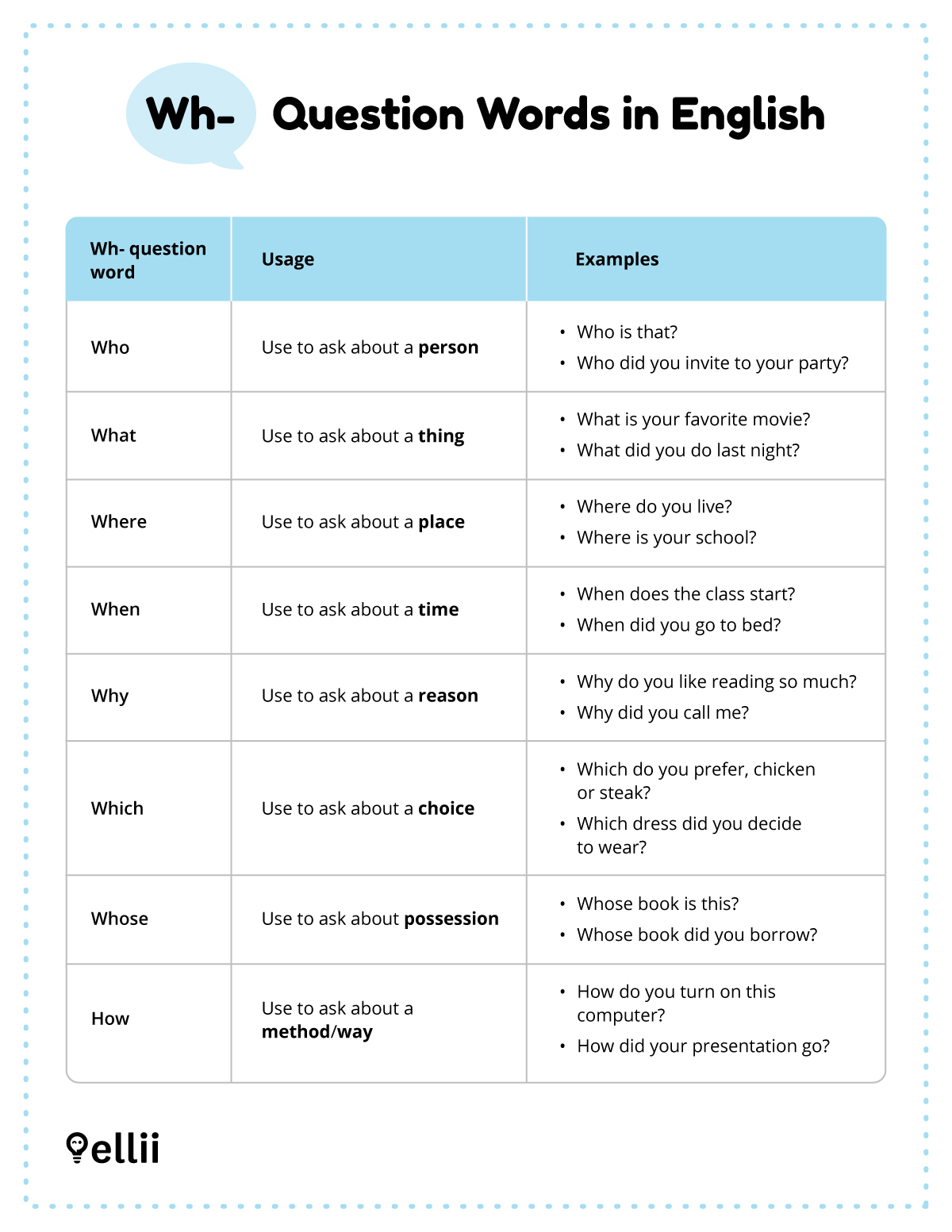
The most common Wh- question words in English are: “who,” “what,” “where,” “when,” “why,” “which,” “whose,” and “how.”
Let’s take a closer look at each Wh- word with examples for context!
Who
Use “who” to ask about a person.
Examples:
| Question | Answer |
|---|---|
| Who is that? | It’s our new teacher. |
| Who did you invite to your party? | I invited Maria, Lee, and Abdul. |
What
Use “what” to ask about a thing.
Examples:
| Question | Answer |
|---|---|
| What is your favorite movie? | I love The Shawshank Redemption. |
| What did you do last night? | I did my homework. |
“What” is often used with another word such as time (to ask about clock time).
Examples:
| Question | Answer |
|---|---|
| What time is it? | It’s 4:30. |
| What time does the show start? | It starts at 8:00 pm. |
“What” is also used before another noun to talk about a choice. It’s usually interchangeable with “which.”
Examples:
| Question | Answer |
|---|---|
| What movie do you want to watch? | Let’s watch the new Star Wars. |
| Which movie do you want to watch? | Let’s watch the new Star Wars. |
| What kind of ice cream do you want? | I would like chocolate, please. |
| Which kind of ice cream do you want? | I would like chocolate, please. |
Where
Use “where” to ask about a place.
Examples:
| Question | Answer |
|---|---|
| Where do you live? | I live in California. |
| Where is your school? | It’s on Somerset Street. |
When
Use “when” to ask about time. When asking about clock time, it's usually interchangeable with "what time."
Examples:
| Question | Answer |
|---|---|
| When do you start your new job? | I start next month. |
| When does the class start? | It starts at 9:00 am. |
| What time does the class start? | It starts at 9:00 am. |
Why
Use “why” to ask about a reason.
Examples:
| Question | Answer |
|---|---|
| Why do you like reading so much? | I like it because I can learn new things. |
| Why did you call me? | I called you to invite you to my party. |
Which
Use “which” to ask about a choice.
Examples:
| Question | Answer |
|---|---|
| Which do you prefer, chicken or steak? | I prefer chicken. |
| Which dress did you decide to wear? | I decided to wear the black one. |
Whose
Use “whose” to ask about possession.
Examples:
| Question | Answer |
|---|---|
| Whose book is this? | It’s mine. |
| Whose car did you borrow? | I borrowed my friend’s car. |
How
Use “how” to ask about a method/way.
Examples:
| Question | Answer |
|---|---|
| How do you turn on this computer? | You have to hold down the power button. |
| How did your presentation go? | It went well. |
Questions with “how” also often involve the way someone is feeling.
Examples:
| Question | Answer |
|---|---|
| How are you? | I’m fine. |
| How do you feel? | I’m nervous. |
| How are you feeling? | Not great. I caught a cold. |
“How” is often used with another word such as “often” (to ask about frequency), “much” (to ask about cost), or “many” (to ask about an amount).
Examples:
| Question | Answer |
|---|---|
| How often do you brush your teeth? | I brush my teeth twice a day. |
| How much does this jacket cost? | It costs $75.00. |
| How many dogs do you have? | We have two. |
Print this cheat sheet to help your English language learners remember the meaning of each Wh- question word.
How to form Wh- questions using patterns
There are two basic patterns you can use to form Wh- questions in English.
1. With no auxiliary
Wh- word + be + subject
Examples:
- Who is that?
- How are you?
2. With auxiliary
Wh- word + auxiliary + subject + verb
Examples:
- What do you want?
- Why did you quit?
What’s an auxiliary verb?
In questions, an auxiliary verb uses words like “do,” “does,” or “did.” It can also be a modal like “can” or “should.” For different tenses, it can be “will” (future), “have” (present perfect), etc.
For basic question patterns and the difference between Yes/No and Wh- questions, see our blog post on Question Formation in English.
Fun class activity with Wh- questions
Ready to get your students practicing questions with Wh- words? For an easy warm-up or filler activity, try doing this student-designed Q&A activity. Here’s how it works:
- Cut up enough blank cards to have five (or 10) per student.
- Get students to write conversation-style Wh- questions of their choosing on their cards. If needed, put some examples on the board (e.g., What’s your favorite dish? When did you start studying English?).
- When they’ve finished writing their questions, collect the cards and shuffle them together.
- Put students into small groups and divide the cards up evenly.
- Have students take turns choosing a question and asking it to one or more of their group members. (You can choose an overall time limit, such as 20 minutes, or let them talk until their cards run out.)
Related materials
- Question Formation in English – Blog Post
- Wh- Questions – Grammar Practice Worksheets
- Question Formation – Grammar & Usage Resource
- Questions Using Various Tenses – Basic Grammar Sentences
Editor’s note: This post was originally published in January 2018 and has been updated for comprehensiveness.
Comments (21)

EnNaji (Guest)
January 19, 2018 at 1:44 pm

Tanya Trusler(Author)
January 20, 2018 at 12:45 am
Vinay (Guest)
January 20, 2018 at 4:35 pm
Tanya Trusler(Author)
January 23, 2018 at 5:25 am
Miss lonely Queen(Guest)
September 11, 2023 at 2:39 pm
Vinay (Guest)
January 20, 2018 at 4:33 pm
Tanya Trusler(Author)
January 23, 2018 at 5:25 am

Anonymous A.(Teacher)
March 13, 2018 at 7:02 pm
Tanya Trusler(Author)
March 13, 2018 at 10:51 pm

Sayyid T.(Teacher)
April 9, 2020 at 12:46 pm
Tanya Trusler(Author)
April 9, 2020 at 5:03 pm
Joseph Adams(Guest)
April 7, 2021 at 3:43 pm

Lei Kayanuma(Ellii Staff)
April 7, 2021 at 9:08 pm

Hablemos F.(Teacher)
August 18, 2021 at 7:29 pm
Lei Kayanuma(Ellii Staff)
August 23, 2021 at 2:48 pm

Malu F.(Member)
July 28, 2022 at 4:52 pm
Tanya Trusler(Author)
July 28, 2022 at 5:57 pm

Ahmad Z.(Teacher)
May 22, 2023 at 4:19 pm
Tanya Trusler(Author)
May 23, 2023 at 8:11 pm
Aflah (Guest)
September 17, 2023 at 1:41 am
Tanya Trusler(Author)
September 18, 2023 at 5:38 pm
Suchi Sharma(Guest)
October 8, 2023 at 12:13 pm
Tanya Trusler(Author)
October 10, 2023 at 11:24 pm
Nagaraj D(Guest)
November 7, 2023 at 7:07 am
Tanya Trusler(Author)
November 7, 2023 at 5:25 pm
Navneet Sehmbi(Guest)
November 27, 2023 at 4:00 pm

Chhabi G.(Student)
November 27, 2023 at 6:03 pm

Dina M.(Member)
December 23, 2023 at 3:52 pm
Tiago Almeida (Guest)
February 11, 2024 at 6:33 pm
Tanya Trusler(Author)
February 12, 2024 at 6:34 pm
acciva travels(Guest)
March 1, 2024 at 9:14 am
Tanya Trusler(Author)
March 1, 2024 at 6:02 pm
Pooja Jadav(Guest)
June 25, 2024 at 2:56 pm
Md Rauf Rauf(Guest)
August 25, 2024 at 6:56 am
Tanya Trusler(Author)
August 26, 2024 at 3:46 pm
Ahati Casimiro (Guest)
September 2, 2024 at 6:18 pm
sudhaacademy academy(Guest)
November 6, 2024 at 9:45 am
Naqeeb Ahmad Amarkhiel(Guest)
May 21, 2025 at 10:03 pm
Tanya Trusler(Author)
May 23, 2025 at 12:30 am