Share this post
[Listen to the full post.]
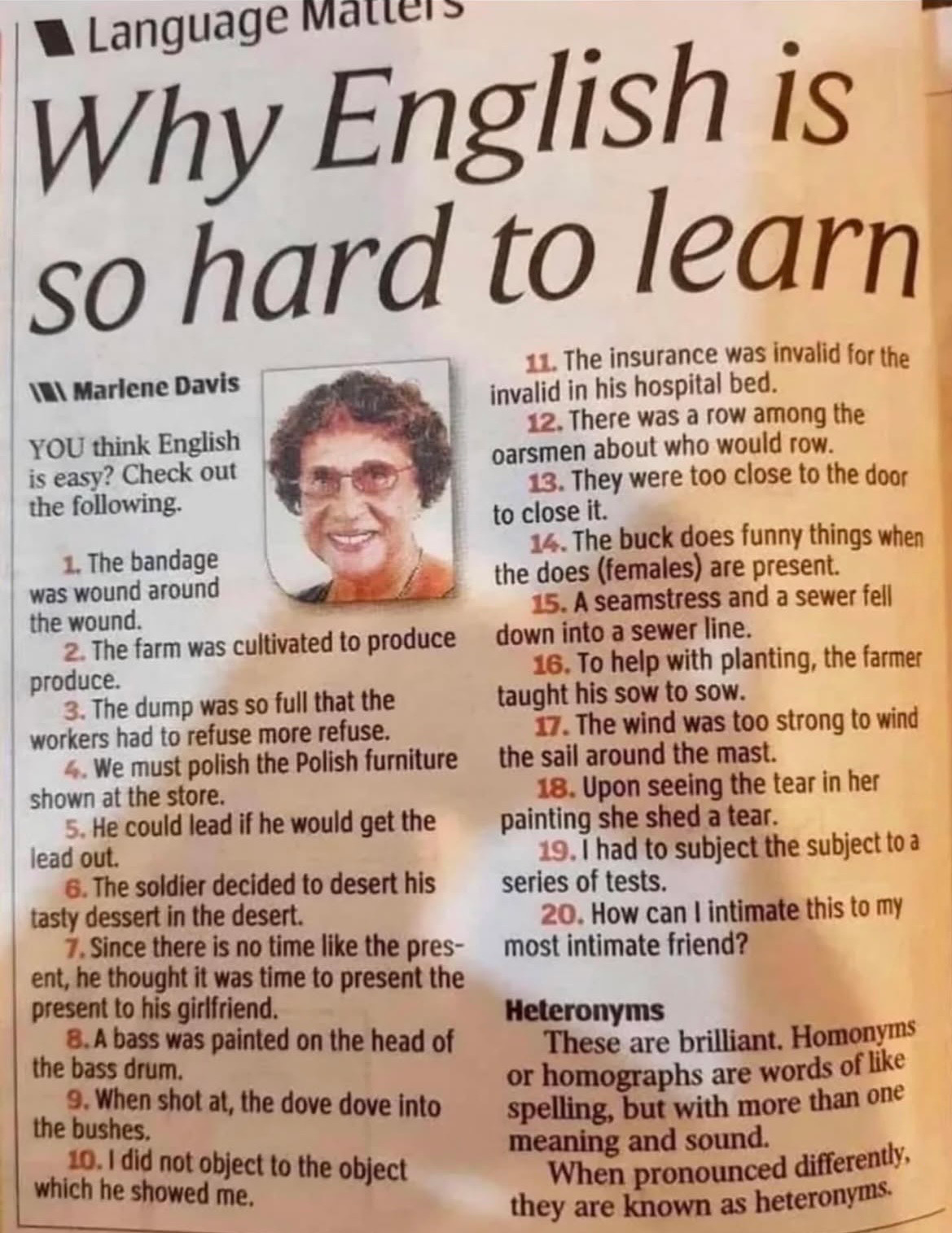
Recently on Instagram, @imgur posted a column titled “Why English Is So Hard to Learn” from an undated, unnamed newspaper. In the column, writer Marlene Davis uses 20 sentences to illustrate how English can be rather tricky.
Quite a few Instagram users disagreed with Davis’s premise that English is indeed a difficult language. One user referred to English as “the fast food of languages,” while another lamented that “literally no one aside from native English speakers thinks that English is hard.” Nonetheless, Davis has chosen an interesting linguistic feature to consider. Her focus is on heteronyms.
In this post, I’m going to explain what heteronyms are and list Davis’s sentences. I’ll also suggest a few activities you can use with advanced ELLs.
Defining heteronyms
Oxford Languages defines heteronyms as follows:
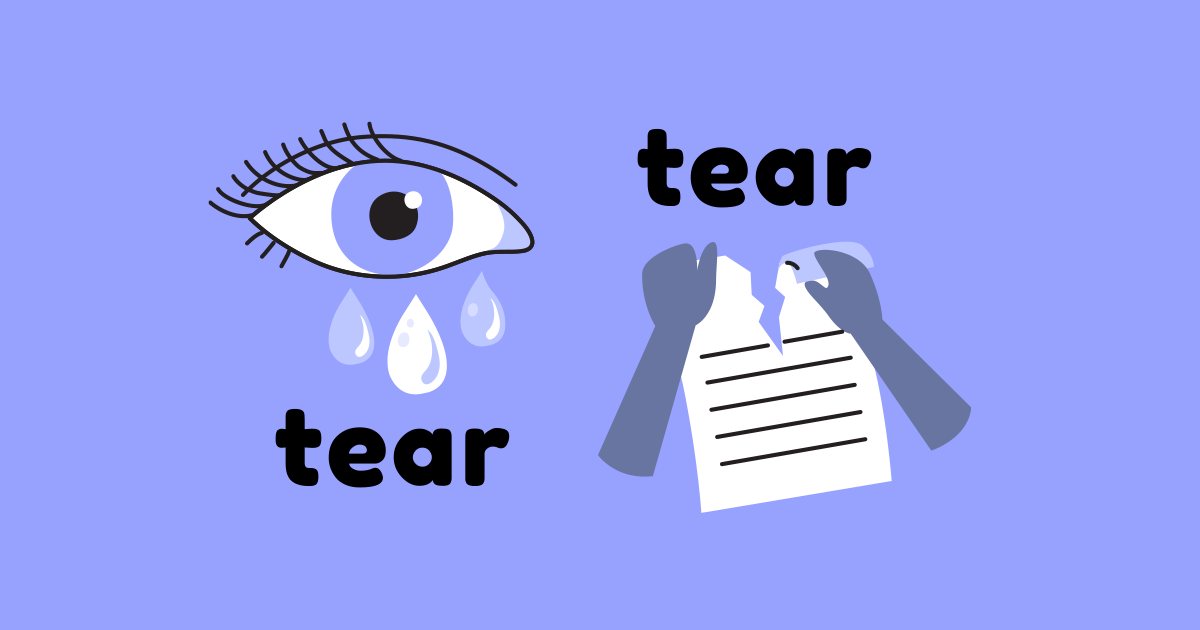
each of two or more words that are spelled identically but have different sounds and meanings, such as tear meaning “rip” and tear meaning “liquid from the eye”
The key to this definition is that, unlike homophones (think “bat” as in a nocturnal flying mammal and “bat” as in a piece of metal or wood used to hit a baseball), heteronyms have different pronunciations in addition to having different meanings.
Davis’s examples
Though you may not often find a set of heteronyms in the same sentence in the real world, Davis’s examples do not sound entirely unnatural. Here’s her complete list:
[Listen to just the list. Right click to save.]
- The bandage was wound around the wound.
- The farm was cultivated to produce produce.
- The dump was so full that the workers had to refuse more refuse.
- We must polish the Polish furniture shown at the store.
- He could lead if he would get the lead out.
- The soldier decided to desert his tasty dessert in the desert.
- Since there is no time like the present, he thought it was time to present the present to his girlfriend.
- A bass was painted on the head of the bass drum.
- When shot at, the dove dove into the bushes.
- I did not object to the object which he showed me.
- The insurance was invalid for the invalid in his hospital bed.
- There was a row among the oarsmen about who would row.
- They were too close to the door to close it.
- The buck does funny things when the does (females) are present.
- A seamstress and a sewer fell down into a sewer line.
- To help with planting, the farmer taught his sow to sow.
- The wind was too strong to wind the sail around the mast.
- Upon seeing the tear in her painting, she shed a tear.
- I had to subject the subject to a series of tests.
- How can I intimate this to my most intimate friend?
Suggested activities
- Read Davis’s sentences out loud as students write them down. Then have students circle the heteronyms in each one. See if they can figure out the meanings and then write two new sentences that clearly show what each heteronym means.
- If you choose not to do the first activity, give students a copy of the sentences or write them on the board. Have students identify the part of speech of each heteronym.
- Ask students to work out the stress pattern for the two-syllable nouns and verbs in Sentences 2, 3, 6, 10, and 19. (If the word is a noun, the stress falls on the first syllable. If the word is a verb, the stress falls on the second syllable.)
- Have students look up the following heteronyms and make note of their pronunciation, part of speech, and definition: resume, minute, live, bow, windy, convict, record, excuse, sake, appropriate.
- Allow students to choose three or four of the heteronym pairs in activity #4 and write a sentence for each set.
- Have students dictate their sentences to a partner. Then have the partner read the sentences back.
Comments (3)

Kate Peters(Ellii Staff)
May 8, 2026 at 4:54 pm

Nancy A.(Teacher)
May 10, 2026 at 2:07 pm

Ann Dickson(Author)
May 12, 2026 at 12:36 am

Trey U.(Teacher)
September 26, 2026 at 6:36 am
Ann Dickson(Author)
September 29, 2026 at 1:03 am