
Share this post
Students learn more quickly when they can visualize a concept…
The simple future can be tricky for English students to learn because there are so many ways to express the future in English. Unlike the simple past, which has one basic form, the simple future can be expressed by using will + base verb, be going to + base verb, or be + ‑ing verb. (See Simple Future: Teaching the Three Forms for complete explanations, practice lessons, and fun activities to do with your students.)
Even though it’s a bit tricky, all three uses are common, so students quickly become familiar with the simple future as they learn English.
But what about the future progressive (also known as the future continuous)? This structure is not commonly used in English, so students don’t come across it very often. However, higher‑level textbooks deal with this form, as do tests like the TOEIC. It is also used occasionally in English writing and speaking, so high‑intermediate and advanced students need to learn it at some point.
Although it is rarely used and thus harder to grasp, presenting the future progressive using the method outlined below will make it easier for your students. Section 6, Tricks, could be especially helpful!
Simple Future
See detailed explanations of the three future forms, examples, practice lessons, and fun activities in my blog post Simple Future: Teaching the Three Forms.
Future Progressive
1. Form
will + be + ‑ing verb
The future progressive is formed by taking the modal will, the base form of the verb Be, and an action verb + ‑ing. Luckily, students don’t have to worry about subject–verb agreement because the Be verb doesn’t change forms after a modal.
What about the other two future forms? We can never use be + ‑ing verb instead of will (She is being eating dinner is clearly incorrect), but it is possible to use be going to instead of will (She is going to be eating dinner). Most people would agree that it’s a bit of a mouthful—sticking to will is best (She will be eating dinner).
2. Use
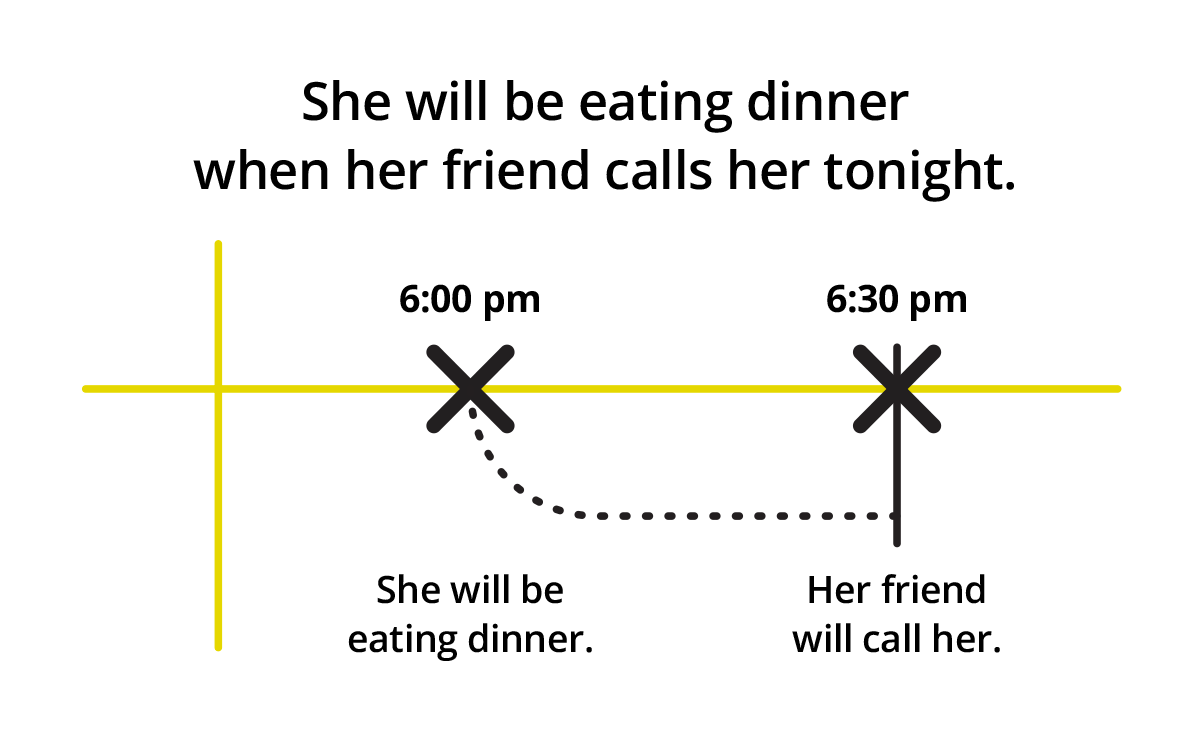
The function of the future progressive is to show a continuing (long) action getting interrupted by a short future action. Using the words long and short helps students understand this use better. The reason the future progressive isn’t used that often is because it’s a little strange to try to predict what will happen exactly at a given moment in the future. Unlike the past, where we know what happened already, we don’t usually know for certain what will happen in the future.
3. Time Marker
The time marker when is common for this case.
4. Examples
- I will be sleeping when you arrive home from work next Friday night.
- They will be doing presentations in class when the practice fire alarm rings at 2:00 pm.
- The mayor will be finishing up her work when the power goes out at the scheduled time tomorrow.
5. Notes
Note #1
Don’t forget to remind students that you can start the sentences with either the independent clause (a Subject-Verb[-Object] structure that can stand alone) OR the dependent clause (that begins with the adverb "when" and can’t stand alone) with no difference in meaning. Students shouldn’t memorize the future progressive as always occurring first in the sentence because this isn’t always the case. Also, remind students that a comma must be used when a dependent clause begins a sentence.
- When you arrive home from work next Friday night, I will be sleeping.
- When the power goes out at the scheduled time tomorrow, the mayor will be finishing up her work.
- They will be doing presentations in class when the practice fire alarm rings at 2:00 pm.
Note #2
Be sure to include some examples with a third person singular subject so that students realize that the regular simple present subject–verb agreement rules must be followed for the verb in the dependent clause. (I.e., the third person singular pronouns he/she/it, singular count nouns, and non‑count nouns all take -s on the end of the verb.)
Note #3
It’s also possible to use the future progressive when a clock time is mentioned instead of a dependent clause.
- What will you be doing at 8:00 pm tonight? (The meaning is: What will you be doing when it is 8:00 pm tonight?)
- I will be studying at 8:00 pm tonight. (The meaning is: I will be studying when it is 8:00 pm tonight.)
Note #4
Another less common use of the future progressive is to emphasize two long actions. The time marker while, followed by a simple present verb, can be used. Likewise, two future progressive verbs can be joined by a conjunction such as "and." Note that all four sentences below have the same meaning.
- He will be cleaning while she cooks.
- While she cooks, he will be cleaning.
- He will be cleaning and she will be cooking.
- She will be cooking and he will be cleaning.
6. Tricks
Trick #1
Use the expression “NO 2 WILLS” to remind students that they will never see two future forms used in the same sentence (if it contains one independent and one dependent clause). Chant it like a mantra in your class—it really sticks in students’ heads and helps them remember to almost always use a future form in the independent clause and a present form in the dependent clause. (See an exception in Note #4 above.)
Remind students that even though the verb in the dependent clause has a simple present structure, both clauses have a future meaning. Point to the diagram at the beginning of this blog post as an example. This is true for all future tenses!
Trick #2
Have students memorize common “short” action verbs so they’ll easily recognize when the future progressive is needed. Short action verbs include: start, begin, call, arrive, ring, come, land, hit, and go out (as in the power goes out or the lights go out).
Trick #3
If students have learned the past progressive before (and they do usually learn the past progressive before the future progressive since it’s more common), remind them that the future progressive has the same function as the past progressive. For more information or as a comparison, see Simple Past Vs. Past Progressive.
7. Practice Lessons
Get some simple future practice with our Simple Future lesson (Grammar Practice Worksheets), our Simple Future Stories lesson (Grammar Stories), and our Future – What are you going to do tonight? and Future - Where are you going to go? lessons (Basic Grammar Sentences).
Practice the future progressive in our Future Progressive lesson (Grammar Practice Worksheets) and compare it with the simple future in our Verb Tense Review 1 – The Simple Tenses lesson.
How will your students be feeling when they finally understand the future progressive? Pretty darn good, I’m guessing!
Comments (26)

Farah Tabsh(Guest)
December 10, 2015 at 2:43 am

Tanya Trusler(Author)
December 10, 2015 at 6:27 am
Farah Tabsh(Guest)
December 11, 2015 at 12:45 am
Tanya Trusler(Author)
December 11, 2015 at 4:32 am
Farah Tabsh(Guest)
December 12, 2015 at 2:06 am
Leanna Pohevitz(Guest)
January 17, 2016 at 7:43 pm
Tanya Trusler(Author)
January 19, 2016 at 5:08 am
danka (Guest)
April 10, 2016 at 1:02 pm
Tanya Trusler(Author)
April 21, 2016 at 1:18 am
Will (Guest)
September 14, 2016 at 9:44 am
Tanya Trusler(Author)
September 14, 2016 at 8:38 pm
Shubhranshu Pandey(Guest)
December 15, 2016 at 5:44 pm
Tanya Trusler(Author)
December 21, 2016 at 7:24 am
Andy (Guest)
November 27, 2017 at 9:30 am
Tanya Trusler(Author)
November 27, 2017 at 10:32 am
Aliaa Ebrahem(Guest)
February 10, 2017 at 10:43 pm
Tanya Trusler(Author)
February 14, 2017 at 12:34 am
Sanya (Guest)
February 24, 2017 at 8:35 am
Tanya Trusler(Author)
February 27, 2017 at 11:29 pm
Kiran (Guest)
March 2, 2017 at 6:50 pm
Tanya Trusler(Author)
March 3, 2017 at 12:02 am
Chetankumar (Guest)
June 16, 2017 at 10:09 am
Tanya Trusler(Author)
June 16, 2017 at 9:50 pm
Shwetha (Guest)
September 28, 2017 at 8:49 am
Tanya Trusler(Author)
September 29, 2017 at 10:49 pm
Hatem Orabi(Guest)
February 15, 2018 at 2:52 pm
Tanya Trusler(Author)
February 16, 2018 at 1:48 am
Reza Foyouzi(Guest)
May 8, 2018 at 10:37 am
Tanya Trusler(Author)
May 8, 2018 at 9:21 pm
Sam (Guest)
June 1, 2018 at 10:13 am
Tanya Trusler(Author)
June 1, 2018 at 11:28 pm
saeed shayan(Guest)
August 6, 2018 at 11:23 am
Tanya Trusler(Author)
August 6, 2018 at 10:32 pm

Thanapon K.(Teacher)
May 26, 2020 at 10:04 am
Tanya Trusler(Author)
May 26, 2020 at 10:35 pm

Olga O.(Student)
August 3, 2021 at 6:04 am
Tanya Trusler(Author)
August 5, 2021 at 2:45 am
Emily Chavarría (Guest)
December 15, 2023 at 3:58 am
Tanya Trusler(Author)
January 10, 2024 at 4:24 pm
Julio Solis(Guest)
December 15, 2023 at 4:01 am
Tanya Trusler(Author)
January 10, 2024 at 4:26 pm
Cynthia Ros(Guest)
January 10, 2024 at 2:02 am
Tanya Trusler(Author)
January 10, 2024 at 4:26 pm
Jeffry Brenes(Guest)
January 10, 2024 at 2:02 am
Tanya Trusler(Author)
January 10, 2024 at 4:27 pm
Yeimy Serrú (Guest)
November 14, 2024 at 1:57 am
Carol Valverde Salazar(Guest)
November 14, 2024 at 1:58 am
Jacqueline Salas(Guest)
November 14, 2024 at 1:59 am
Andres benavides(Guest)
November 14, 2024 at 2:03 am
Yailin Salas(Guest)
November 14, 2024 at 2:07 am
Tanya Trusler(Author)
November 14, 2024 at 6:29 pm