
Share this post
This year at the TESOL convention in Baltimore, the ESL Library team had two booths to manage and three presentations of our own to give. There wasn't enough time to attend all of the sessions we wanted to, so we had to be very picky with our selections!
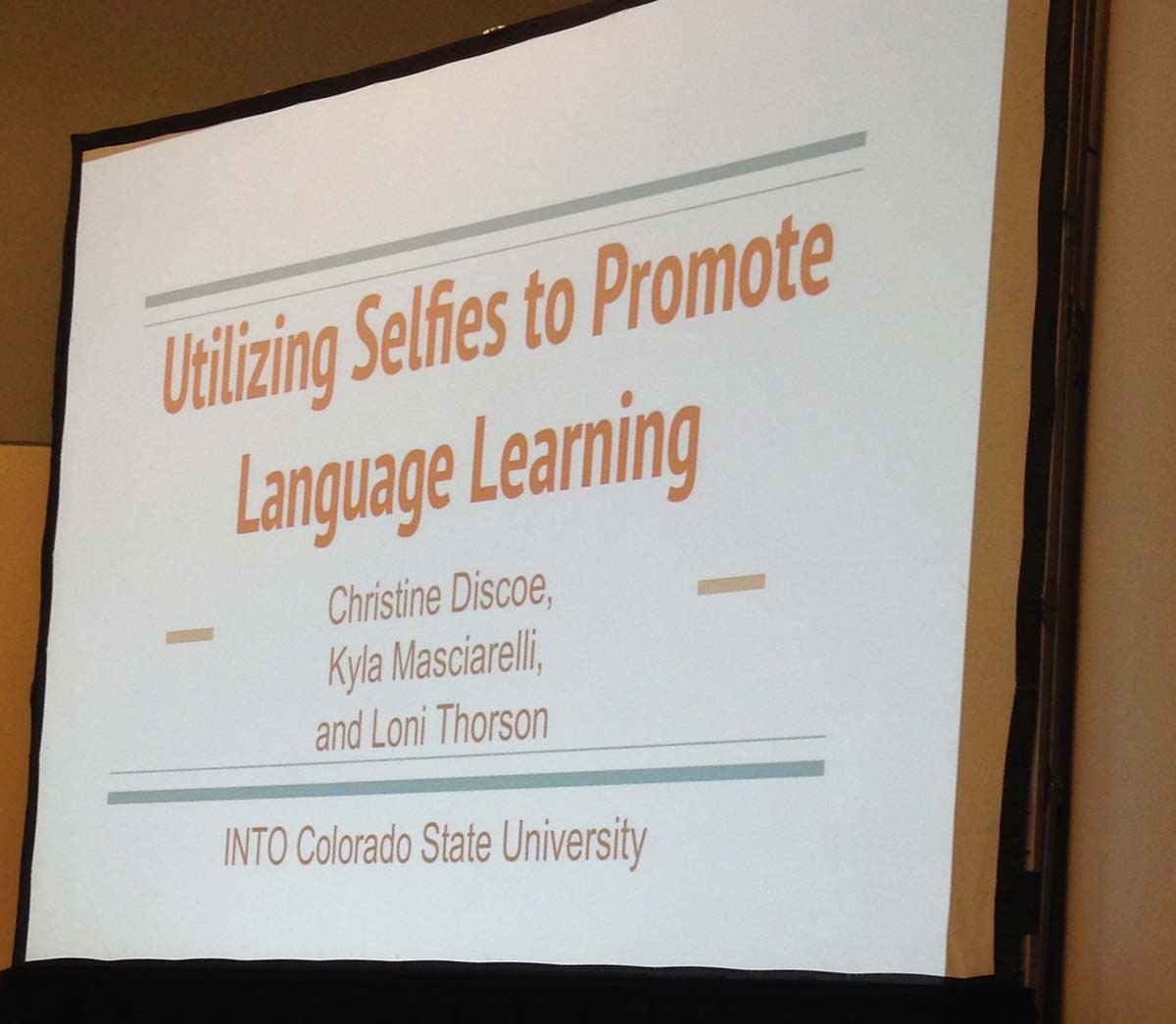
Here is a brief overview of a fantastic TESOL session that I attended in Baltimore about using selfie videos in the language classroom. Be sure to view the slides from this session if you are interested in learning more.
| Session Title: | Utilizing Selfies (Videos) to Promote Language Learning |
|---|---|
| Speakers: | Christine Discoe, Kyla Masciarelli, and Loni Thorson from Colorado State University |
Rationale for assigning selfie videos to English learners
Here are the top three reasons the speakers provided for assigning selfie videos to language learners.
1. Comfort
Students feel more comfortable when they have their mobile devices in their hands. Selfie videos allow students to become more comfortable with their teachers and their peers. Young adults rate selfie video assignments as 'highly effective.'
"Smart phones are leading the mobile charge."
2. Awareness
With selfie videos, students can see themselves using the language. They want to look and sound better, so they work hard to improve their language and correct their own errors. They learn to self-correct.
"They have an innate desire to self-correct and to make themselves look and sound good."
3. Creativity
There are many different types of selfie assignments that teachers can give. Students play with the language and try it out in many ways. Students love experimenting with different backgrounds, locations, and video apps. They learn to speak 'on the fly.'
"Students really have to try on different structures."
Examples of selfie video assignments
The speakers regularly assign up to three selfie videos per student each week. Here are some of the examples of selfie video assignments that they shared.
- tell two truths and a lie and get other students to guess which is a lie
- practice telling jokes or using sarcasm
- summarize what you read, saw, or heard
- paraphrase someone else's thoughts
- practice minimal pairs
- use target grammar or vocabulary
- share your opinion about a topic discussed in class
- describe one's surroundings
- walk and talk in English
Ideas for submitting and sharing selfie videos
Christine and co. offered several suggestions for submitting selfie videos to the teacher and/or class. They recommend setting a two- to three-minute maximum for submissions.
- pass mobile devices around the classroom (set to Airplane Mode to avoid any embarrassing notifications)
- upload videos to Google Drive and share
- display videos on a 'document camera' for the class to view
- watch in a 1–1 selfie conference with the teacher
- upload to a Learning Management System (LMS) and share with the class or teacher
Assessment and feedback with selfie videos
The speakers explained that selfie videos can be used for diagnostic testing as well as formal assessment. Selfie videos can help teachers identify certain sounds and structures that individual students need to work on. The students should know ahead of time who the audience will be (e.g., just the teacher, classmates, public).
Teachers can respond with a selfie video to provide suggestions and model corrections. Check out TESOL slide #28 from this session for a useful selfie video rubric.
How to integrate selfie video assignments into ESL Library lessons
We love the idea of using selfie videos in the ELL classroom, and we'll be adding some video tasks into some of our new and revised lesson plans. You can also add your own selfie video assignments to existing lessons. Here are some ideas you can use now if you are an ESL Library subscriber.
- Assign the Warm-Up questions from a lesson the night before starting a lesson, and watch a few selfie videos in class before starting the lesson.
- Assign a Discussion Starters question as a selfie video response after doing a lesson.
- Assign a Mini-Debates question as a selfie video response (could have two students in the selfie debating an issue) before doing the classroom debate.
- Ask students to summarize what they learned in a reading or podcast from an ESL Library lesson (e.g., summarize a biography from the Famous People section).
- Ask students to make a 'two truths and a lie' selfie video after learning about a subject from an ESL Library lesson.
Tara's 30-second post-TESOL selfie video
If we're going to assign selfie videos to our students, we'll have to work on becoming comfortable in front of the camera, too. The speakers challenged us to give it a whirl. This selfie took three takes! It's harder than it looks.
Learn all about how Baltimore charmed the ESL Library team.
Comments (5)

Christine Discoe(Guest)
April 19, 2016 at 2:42 am

Tara Benwell(Author)
April 19, 2016 at 9:05 am

Tiffanie S.(Teacher)
May 4, 2016 at 7:26 pm
Tara Benwell(Author)
May 5, 2016 at 6:17 pm
Chris Fry(Guest)
July 10, 2016 at 4:23 pm
Tara Benwell(Author)
July 11, 2016 at 6:00 pm
Tara Benwell(Author)
October 12, 2016 at 5:08 pm