
Share this post
When learning the present progressive (or present continuous) tense, my students would often get confused by certain verbs that remain in the simple present even with a present progressive time marker like “now” or “right now.” These non‑action verbs (or stative verbs) also have many exceptions to the general rule.
Help is here! Try teaching your English language learners about non‑action verbs and exceptions using the tried-and-tested method below.
Categories of Non-Action Verbs
Non-action verbs are verbs that involve no movement or action. Students will remember common non‑action verbs more easily if you teach them the five main types of verbs. These categories include state, possession, feelings and needs, thought, and the senses. See examples in the chart below.
Remind students that progressive tenses (be + ‑ing verb) usually can’t be used with non‑action verbs (but see Exceptions below). This rule is especially important when students are learning the present progressive.
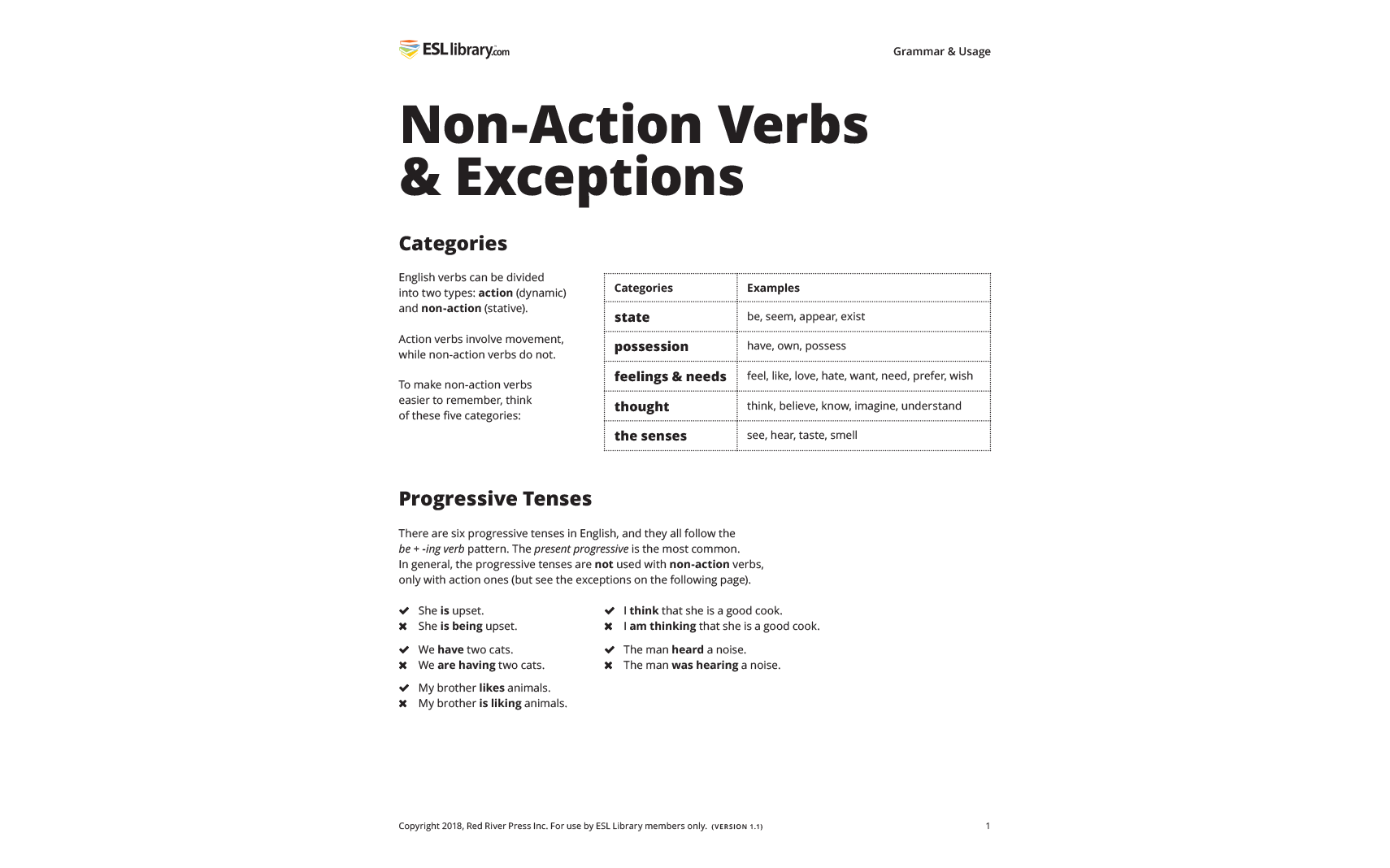
Non-Action Verbs & Exceptions – Grammar & Usage Resources
Exceptions
For intermediate‑level learners and above, it is important to learn that there are many exceptions to the “non‑action verb = no progressive tense” rule because these exceptions are quite common.
A. Non-Action Verbs with Action Meanings
Many non‐action verbs have another meaning. If this second meaning is an action meaning, a progressive tense can be used.
- My child is being a brat at the moment. (= misbehaving)
- We are having dinner. (= eating)
- She is having a baby. (= giving birth, delivering)
- He is having fun. / He is having a good time. (= enjoying)
- I am thinking of buying a new car. (= planning, deciding)
- They are seeing a movie. (= watching)
Some non‑action verbs don’t have a change in meaning, but a progressive tense can be used to emphasize a longer, continuing action.
- My son feels sick.
- My son is feeling sick.
- She has wanted a new dress for ages.
- She has been wanting a new dress for ages.
- I love Netflix.
- I’m loving Netflix.
B. Action Verbs with Non‑Action Meanings
Some verbs that are usually action verbs can also change meaning. With the non‑action meaning, a progressive tense should not be used.
- You are looking out the window. (action)
- You look nervous. (non‑action)
- You are looking nervous. (non‑action)
- The children appeared at the window. (action)
- They appear calm. (non‑action)
- They are appearing calm. (non‑action)
Practice
Try our Simple Present Vs. Present Progressive lesson in the Grammar Practice Worksheets section for more practice with non‑action verbs. Note that this lesson will be updated in the next few months and will soon include grammar notes and charts. Subscribers can also download and print the Non‑Action Verbs & Exceptions PDF, which includes a second page of exceptions.
Comments (11)

IULIA WEIR(Guest)
September 22, 2017 at 11:06 pm

Tanya Trusler(Author)
September 22, 2017 at 11:10 pm
Mayyah (Guest)
November 3, 2017 at 11:33 pm
Tanya Trusler(Author)
November 3, 2017 at 11:49 pm
Ahmad (Guest)
November 28, 2017 at 10:26 am
Tanya Trusler(Author)
November 30, 2017 at 1:59 am
Yousif (Guest)
December 1, 2017 at 1:13 pm
Tanya Trusler(Author)
December 5, 2017 at 3:17 am
Julia (Guest)
February 16, 2018 at 4:08 pm
Tanya Trusler(Author)
February 21, 2018 at 2:44 am
siti (Guest)
April 29, 2018 at 8:57 pm
Tanya Trusler(Author)
May 1, 2018 at 3:38 am
Sara Portillo(Guest)
April 20, 2020 at 8:42 pm
Tanya Trusler(Author)
April 20, 2020 at 10:36 pm
Oscar Zepeda(Guest)
July 2, 2020 at 4:17 pm
Tanya Trusler(Author)
July 2, 2020 at 11:15 pm
Juliet Solomons(Guest)
December 14, 2020 at 10:29 am
Tanya Trusler(Author)
December 15, 2020 at 1:33 am
Helia (Guest)
September 19, 2021 at 6:56 am
Tanya Trusler(Author)
September 22, 2021 at 10:34 pm
Abhishek CS(Guest)
January 25, 2023 at 9:42 am
Tanya Trusler(Author)
January 26, 2023 at 2:08 am