
Share this post
“Life lessons will be repeated until learned.”
Last week, our customer Sandra asked us if it were possible to use both learned or learnt in the quote above. (I’m not sure who originally said this quote—if anyone knows, please leave a comment below!)
The short answer is yes, both are possible. So what’s the difference? Why do we have two forms for the same tense of the same word?
It depends where you live…
The ‑ed form is more common in American and Canadian English, while the ‑t form is more common in British English. The fact that Canadian English uses the ‑ed form is a bit surprising, since Canada usually follows British English spelling rules.
Learned = American & Canadian English
Learnt = British English
Which is more common in print (books)?
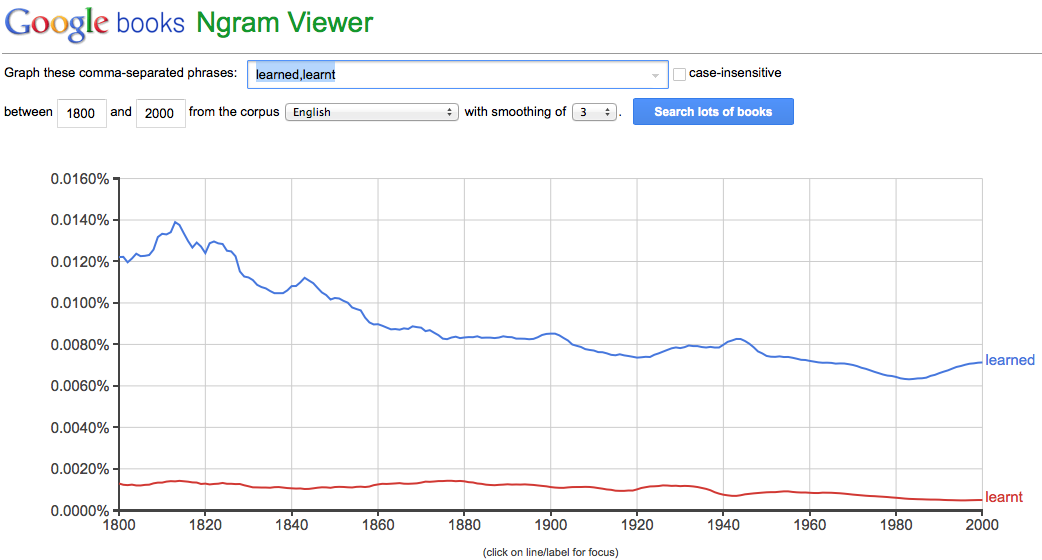
Even back in the 1800s, learned was used far more often than learnt, according to Google books Ngram Viewer.
Which is more common on the web?
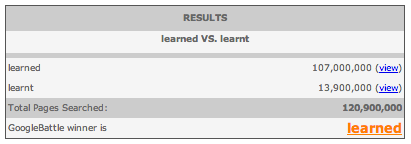
According to GoogleBattle, learned shows up online much more often than learnt. Out of 120,900,000 pages searched, learned appears 107,000,000 times compared to learnt at 13,900,000 times. Googlefight has even stronger results for learned, with 4,910,000 results compared to 38,100,000 for learnt.
Looking back and looking forward…
The evolution of language is fascinating to me. In North America, many verbs such as learn have all but lost their irregular form. Learnt sounds way too formal and out of place nowadays in North America and elsewhere. Other such verbs include clapped/clapt, leaned/leant, spoiled/spoilt, and smelled/smelt.
However, some verbs are still in the transitioning stage (dreamed/dreamt, kneeled/knelt, leaped/leapt, burned/burnt, spilled/spilt, sunburned/sunburnt, sweeped/swept), so both forms are common and acceptable. For these words, I would still recommend using the ‑ed form in North America and the ‑t form elsewhere.
It’s interesting to note that some ‑t past verbs don’t have an ‑ed form—yet! How about slept, wept, and kept? Will we be using sleeped, weeped, and keeped one day, or are they too tricky to pronounce and will therefore remain as is?
Comments (5)

Sam (Guest)
December 10, 2013 at 3:27 am

Tanya Trusler(Author)
December 10, 2013 at 4:22 am

Anonymous A.(Teacher)
October 19, 2017 at 7:04 am
Tanya Trusler(Author)
October 20, 2017 at 1:00 am

Luke M.(Teacher)
May 25, 2022 at 9:13 am
Tanya Trusler(Author)
May 26, 2022 at 5:49 pm

Ilse Paola O.(Teacher)
February 10, 2025 at 11:49 pm
Tanya Trusler(Author)
February 11, 2025 at 12:54 am

Kelly B.(Teacher)
August 12, 2025 at 11:28 am
Tanya Trusler(Author)
August 12, 2025 at 5:44 pm