
Share this post
An embedded question is a question that is inside another question or statement. This grammar point is sometimes explained on its own or in a lesson on noun clauses or reported speech (more on this below).
Tip
To help students remember what an embedded question is, think of “embed” as “in bed.” When you’re in bed, you’re tucked in between the sheets. An embedded question is simply a question tucked inside another one!
Embedded questions can cause confusion for English language learners because they follow a normal Subject-Verb-Object pattern instead of a typical inverted question pattern. Let’s take a closer look!
Two Types
1. Embedded Questions within Questions
Here are some examples of an embedded question within another question. For patterns and uses, see the notes below the charts.
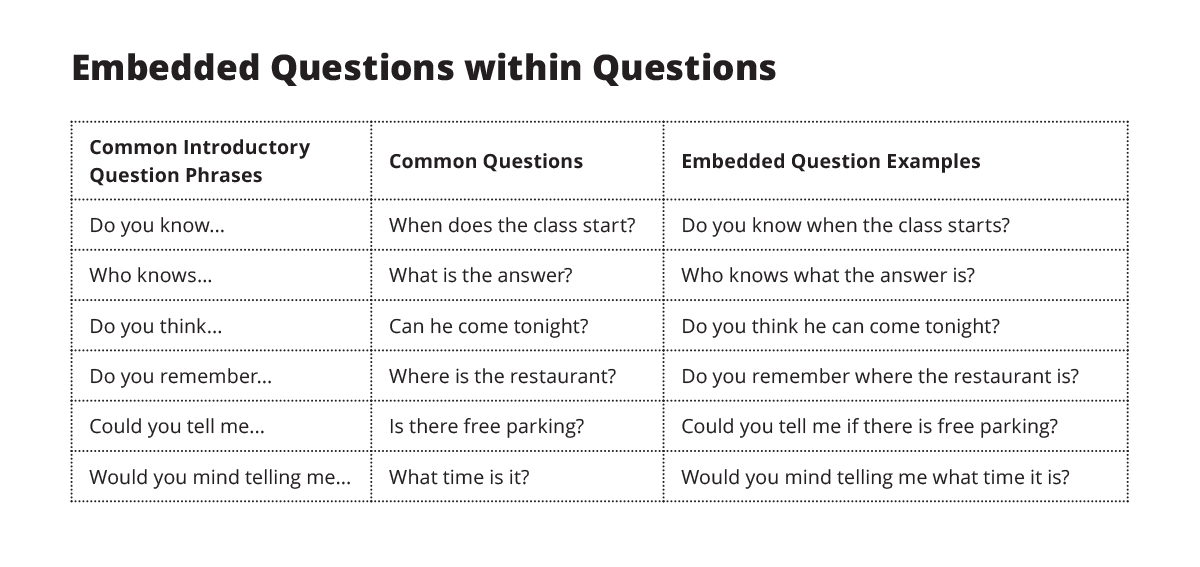
Embedded Questions – Grammar & Usage Resources
2. Embedded Questions within Statements
Here are some examples of an embedded question within an affirmative or negative sentence. Note that we do not use a question mark for these statements even though they contain a question.
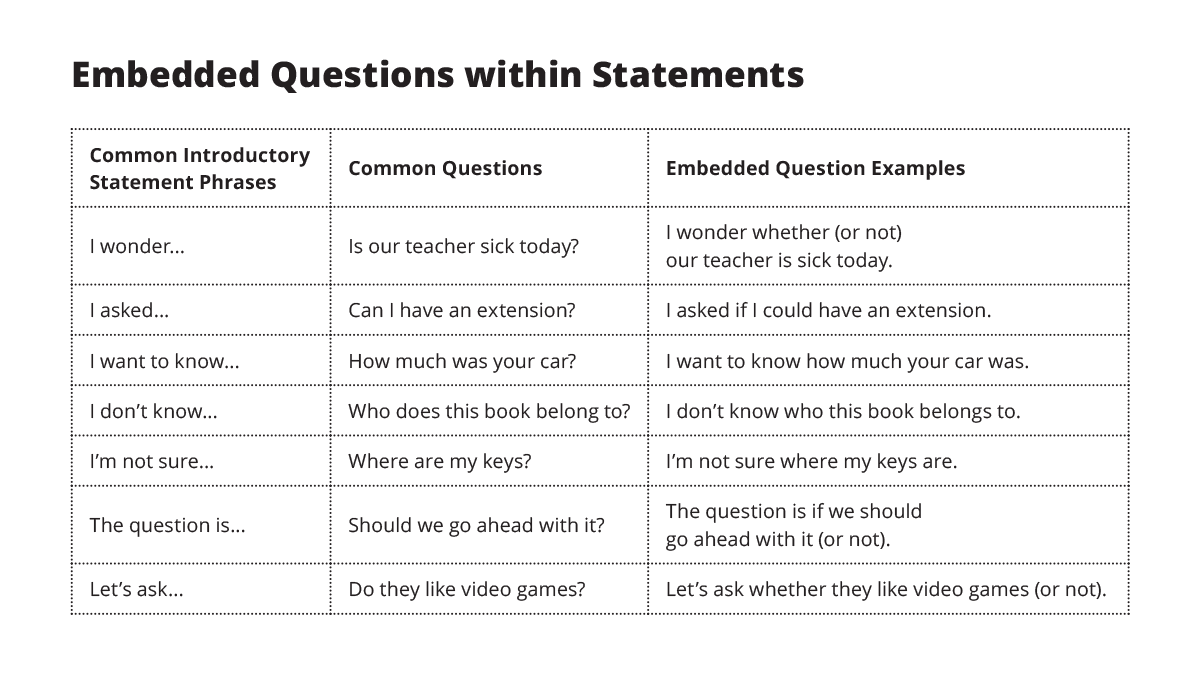
Embedded Questions – Grammar & Usage Resources
Patterns
1. Sentence Pattern
A normal English sentence follows this pattern: Subject + Verb (+ Object) or SVO.
- She (S) sang (V).
- The girl (S) walked (V) her dog (O).
2. Question Pattern
A normal question has an inversion of the sentence pattern, and looks like this: (Question Word) + Auxiliary Verb + Subject + Main Verb (+ Object) or VSVO. For the Be verb, it looks like this: VSO.
- What (Question Word) did (Aux V) he (S) say (V)?
- Do (Aux V) you (S) like (V) pizza (O)?
- Is (Be) he (S) sleepy?
3. Embedded Question Pattern
In an embedded question, the question inside the statement or other question follows a sentence pattern instead of a question pattern: SVO. The introductory phrases follow the normal sentence (SV) or question (VS) patterns.
- I (S) don’t know (V) [what (question word) I (S) should do (V)].
- Do (Aux V) you (S) think (V) [we (S) need (V) more time (O)]?
Uses
When and why do we use embedded questions in English?
1. To be more polite
- What time is it? (normal question)
- Could you (please) tell me what time it is? (embedded question = more polite)
2. To give more information
- I wonder if she’ll call me. (expresses curiosity)
- I don’t know where my bag is. (expresses lack of knowledge)
- I want to know when this meeting will start. (expresses desire for knowledge)
3. To change direct speech to reported (indirect) speech
- “What do you want to know?” (direct speech)
- He asked me what I wanted to know. (reported speech)
Notes
Note #1
Embedded questions are a type of noun clause. A noun clause is a complete sentence (SVO) that serves as a subject or object of another sentence.
- What do you mean? (SV)
- I don’t know (SV) [what you mean (SV)]. (What you mean serves as the object of the sentence I don’t know.)
Note #2
Don’t use contractions at the end of an embedded clause. (Tell students this follows the same rule as short answers in English—we can say Yes, he is but we can never say Yes, he’s.)
- Do you know what time it is?
- Do you know what time it’s?
Note #3
Who knows is used for questions, but it can also be used for statements. English speakers often use this phrase as a statement when they are surprised or frustrated.
- Who knows the answer to #2?
- Who knows what she meant by that.
- Who knows when this week will start getting better!
Related
Comments (18)

WK (Guest)
December 1, 2016 at 2:27 pm

Tanya Trusler(Author)
December 2, 2016 at 2:20 am
Shanker Banavath(Guest)
March 4, 2022 at 10:47 am
Tanya Trusler(Author)
March 8, 2022 at 2:02 am

Allan B.(Teacher)
July 5, 2017 at 6:33 pm
Tanya Trusler(Author)
July 5, 2017 at 8:42 pm
Allan Benavides(Guest)
July 7, 2017 at 5:39 am
Tanya Trusler(Author)
July 7, 2017 at 10:36 pm
MUHAMMAD (Guest)
November 3, 2017 at 3:03 am
Tanya Trusler(Author)
November 3, 2017 at 3:20 am
Mahmud Sazid(Guest)
November 4, 2017 at 9:45 am
Tanya Trusler(Author)
November 9, 2017 at 12:11 am
Jamie Lee(Guest)
February 3, 2018 at 12:20 am
Tanya Trusler(Author)
February 3, 2018 at 2:00 am
Maryam (Guest)
June 29, 2018 at 4:59 pm
Tanya Trusler(Author)
July 2, 2018 at 10:27 pm
Vicky (Guest)
September 21, 2018 at 2:22 am
Tanya Trusler(Author)
September 21, 2018 at 2:38 am
Gopal Bhattarai(Guest)
November 20, 2018 at 9:14 pm
Tanya Trusler(Author)
November 21, 2018 at 5:01 am
Masoud (Guest)
December 1, 2018 at 8:24 pm
Tanya Trusler(Author)
December 12, 2018 at 4:31 am
Ashna (Guest)
March 15, 2019 at 6:50 pm
Tanya Trusler(Author)
March 20, 2019 at 11:32 pm
ati dh(Guest)
January 26, 2020 at 5:00 pm
Tanya Trusler(Author)
January 29, 2020 at 1:56 am
Liena Rose(Guest)
January 27, 2020 at 4:41 pm
Tanya Trusler(Author)
January 29, 2020 at 2:03 am
Akbarshoh (Guest)
January 25, 2021 at 7:15 am
Tanya Trusler(Author)
January 26, 2021 at 3:22 am

Jenalee P.(Teacher)
December 12, 2022 at 3:23 pm
Tanya Trusler(Author)
December 13, 2022 at 1:23 am
Jenalee P.(Teacher)
December 13, 2022 at 6:31 pm
Tanya Trusler(Author)
December 14, 2022 at 12:50 am

Bahar H.(Teacher)
September 19, 2024 at 2:41 am
Tanya Trusler(Author)
September 19, 2024 at 4:26 pm
Bahar H.(Teacher)
September 19, 2024 at 7:20 pm
Tanya Trusler(Author)
September 19, 2024 at 10:58 pm
Bahar H.(Teacher)
September 20, 2024 at 12:22 am
Tanya Trusler(Author)
September 20, 2024 at 5:47 pm